The Canton Spring of Stanly County

For those reading my new book, Finding Big Lick, one of the chapters concerns Elvis Presley’s ancestral family, their migration south, and their relevance to the place I seek to understand. Several years of intensive study culminated recently in publication, but for now, the topic of a monthly meeting of the Stanly County Historical Society has greatly hastened my discoveries.

This summer, J.D. Burleson and Debbie Noah gave a talk about the Harward family group’s trip to Virginia to restore an ancient cemetery.  The stone wall around the burial site was cut, and a new entrance, including a wrought-iron gate, was provided. What a road trip and fabulous adventure the group must have had.

An aside, a conversation at the Gen Society meeting focused on the community north of Canton Road, where the Burleson and Harward families are deeply rooted. Afterward, J.D. Burleson graciously led me to the place, and I was able to lay eyes on the Burleson Cemetery and a marker for the historic Cassell Meeting House—a critical first step in getting to know the place and its family history. We discussed earlier efforts by John Hoyle Burleson to locate Burleson family lands based on mapping studies and his placement of the old Cassell Meeting House cemetery.  I remember John H. from online discussions in the early 2000s. Those were good days, and I am glad now to be working to honor and build upon his efforts. This was a beautiful fall day in rural Stanly County, and all along I kept thinking that this really could be it; the abundance of springs and streams in the area made me feel that the Canton and Little Bear Creek areas might turn out to be the focus of my search – something hinted at in my book. However, I had not discussed any possibilities with others. That conversation begins now.

Many places in the early 1800s took the name Canton. There was Canton, Ohio, which was named in honor of an early silk trader.  And even in the mountains of North Carolina, the place we call Canton was named after Canton, Ohio. The steel used to build the first iron bridge across the Pigeon River came from Canton, Ohio.  Furthermore, the word Canton originated in Guangzhou, China, and was later Romanized as Canton. Located on the Pearl River, this place has been recognized as the eastern terminus of the Silk Road for over two thousand years. There are other meanings of the word Canton, as found in Switzerland and France, to denote geographical regions; this use derives from the Latin form, “canto,” meaning corner or angle. One might expect the naming of the community in Stanly County to be similarly rooted. Still, driving through the fertile fields of waving grain, the traveler is welcomed by a wealth of streams and springheads. A quality one cannot overlook, and nothing new; area folks realize their good fortune and have acknowledged the blessings for a long time.

As early as 1850, George Whitley sold to Richard Harris 52 acres “no. of the Canton.”  The small and seemingly otherwise insignificant tract of land joined the “Vinyard tract” and properties owned by Martin Almond, Sallie Almond, Daniel Moose, and Joshua Hearne. I am actively in motion, working to physically locate what I believe is an essential puzzle piece of property. Still, for the moment, the property survey and its metes and bounds do not close, indicating a serious error that needs to be resolved. I think that will happen sooner rather than later, but I wanted to get this story out to you.

The land in question was later sold to William Eudy before George C. and James R. Mendenhall of Guilford County sold a nearby or adjoining tract to Martin Almond in 1880. Note that William’s daughter, Keziah [Kizzie], married George Whitley, who, together, lie at rest along Little Bear Creek in the Keziah Whitley burial ground. Mentioning landmarks and abutments, likely from earlier and lost iterations of conveyances, the property is located west of Little Bear Creek and is recorded as crossing “Canton Road,’ east of the “Canton School–House tract.” I can imagine the surveyor writing the following, that the first property line began at a “small black gum one pole north of the Canton Spring.”  By the way, a pole is a measuring stick that equals 16 ½ feet, and four poles equal the length of a chain. Wowser, and as further written, the survey actually passed “through the “fountain head of said spring,” and crossed north of Canton Branch.  Also named in this conveyance are adjoining landowners William Burroughs, Elisha Honeycutt, Jr, and Larkin Almond.

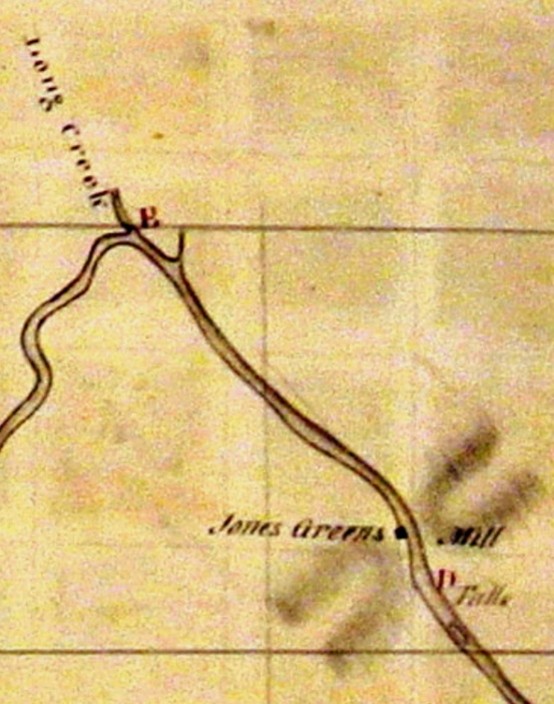
There happened to be other nearby springs, including the “fountain head” of Muscle Springs. The term fountain head denotes a fountain or spring from which a stream flows; the head or source of a stream; the chief source of anything. Can you imagine?  Was the use of “fountain head” a marketing ploy, or were residents sincerely proud of their spring? Historically, were such water sources truly exceptional?  Many springs are mentioned in the annals of Stanly County, with but a few rising to be labeled fountains. Today, remembered as an important landmark, one such spring in Fayetteville is preserved in a local city park. I’d love to walk the land and see Stanly County’s Canton Spring.

But back to the book, last week, after pushing the button to publish online, I immediately turned my attention to Canton Road and the conversation from the recent genealogical society meeting. My heart and personal interest lie in southwest Stanly County, but I want folks to know that my wild idea to map the county is for real.  No better place to move beyond my own interests than to take in a study of Burleson and other family lands along Canton Road. What a place to study! I welcome your ideas, which provide reason to study other such places.  But, in time.

My book is published, and incredibly, after much digging and before the proverbial crow called out to welcome the dawning day, much midnight oil had been burned, and pieces of understanding found their way to me through a late-night work session.  Oh, and then there is the King, Elvis I mean. This tidbit does not represent his direct lineage, but I love finding ties that bind my beginnings to famous people. Like dropping names in a public gathering, doing so somehow gives me a lift from my ancestral beginnings, often rooted in red clay, as expressed by my elders, who, they say, experienced the place while plowing fields from the south end of a north-bound mule.

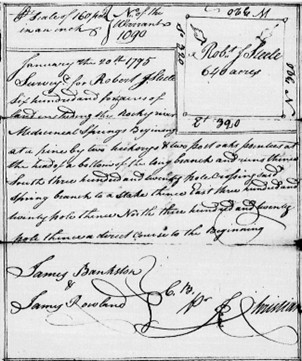
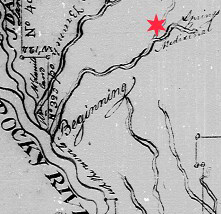
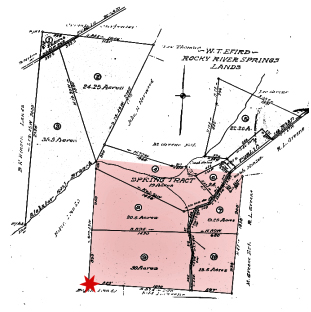
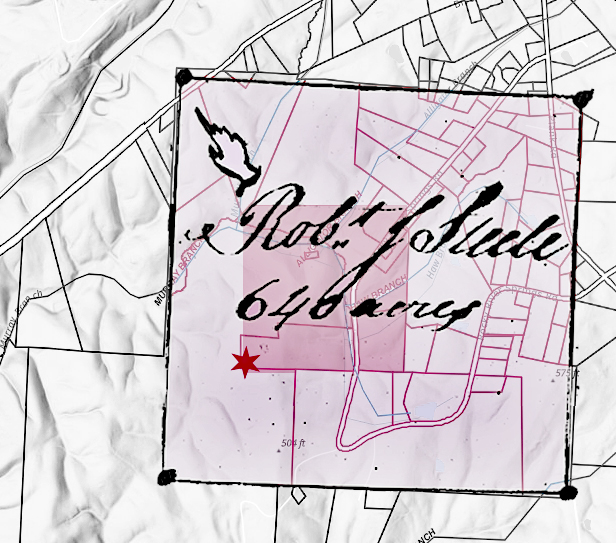
As shown to the right, and nearly 100 years after Andrew Presley received a patent for 100 acres, Isaac Burleson sold Howell Burleson the adjoining land to the south. The two were neighbors, though maybe living in ever-so-slightly different times. This land lies indeed near the Canton Spring, and Andrew Presley certainly had reason to call it out as he did.  Hint: even from the 1700s acquisition by Andrew Presly, the place name confused my understanding of a nearby, more historically significant spring.


I am now growing a healthy pile, actually piles, of land grant surveys and platted conveyance surveys from which to reconstruct the area’s early history. Surnames for the land I’ve platted in the neighborhood thus far include: Burleson, Stokes, Almond, Eudy, Hatley, Hearne, Whitley, Mann, Presley, Vanhoy, Bowers, Mason, Gatewood, Mann Harward, Harris, Hathcock, Marshall, Herlocker, Smith, Roper, and others.

The joining of land plats is an extremely valuable tool for understanding business and even family relations; however, much more can be gleaned if I were only able to take the next step and overlay the hand-drawn properties onto a modern-day map. For now, I am dealing with matters of relating land through time, the concerns of missing records, and the alteration of boundary lines caused by life and the need of generations to move forward. I hope to address the area soon in a more compelling way and think that will happen, but doing so will take time to accomplish, possibly by the end of January. So please do stay in touch!

Finding Big Lick: Roads, Families, and the Nature of Licks

Purchase here on Amazon

“…entering Oakboro from the north, the school grounds are on the left before reaching the town’s business district. I believe, without realizing it, everyday citizens unceremoniously come face to face with the origin of the Big Lick after passing a small diner just beyond the tractor supply store on the left. Tammy’s Oakboro Restaurant, the place I am thinking about appears on 2022 Google Maps within a small business complex where I believe the back side of an idled advertisement sign should exclaim, “You have arrived!” or maybe “This really is it!”

 The water trickling from a nearby culvert is Alison Branch, which empties into Stony Run before flowing into Big Bear Creek and Long Creek on its way to the Rocky River. Alison Branch? This is it?

 Standing quietly at the iron safety railing overlooking the waters below, one might think of Alison Whitley, for whom the stream, once called Lick Branch, is named. Let your mind wander as you contemplate the past, imagining Alison working his 136 acres during the Civil War. Alison died before the nearby town of Big Lick burned in 1898, and after his death, one might have witnessed the funeral and heard the somber cries from the family cemetery just a short distance downstream.”

Beyond its academy and the whistle-stop town that sprang up nearby, the Big Lick crossroads was significant beyond common belief. Big Lick was my father’s home, the place I chose to launch a formal exploration of Stanly County through the mapping of its land. I will be calling on you for help, but for now, having studied land records for nearly 30 years, I believe it is critical to correct mistaken beliefs and secure a broadly held consensus beyond the folksy traditions rooted in broken history.

Not at all a fictional tale of what life may have been like, this deep dive into land and other period documents chronicles the walks of many people and their spread into and through the Carolina backcountry. Most of us know the families of Cagle, Whitley, Austin, McLester, Hathcock, Kennedy, and many more.  However, others, such as Whitfield, Roach, Narron, Harrington, Barringer, and Phillips, are equally significant to our beginnings. This writing reaches back to the days of Indigenous Peoples and applies to counties up and down the Rocky River. Yes, there was the Great Wagon Road, but there is much more.

Did you know that one man and his associates once privately owned more than 75% of Stanly County? The University of North Carolina owes its existence in part to funding realized from the sale of confiscated land purchased by our ancestors. There was ye Great Lick, and what about the family of Elvis Aaron Presley, who lived at a place they called “the Bigg Lick.”

This book is printed in color to enhance its numerous maps and graphics. I believe the message within is a must-have for people who own or live on land in the county as well as for others who descend from families who once called Stanly County home. A detailed guide of sorts, Finding Big Lick should make a good Christmas gift for anyone sincerely interested in the history of Stanly County and the surrounding Rocky River region.

1836: Through the Rudes of Rutherford to Chimney Rock

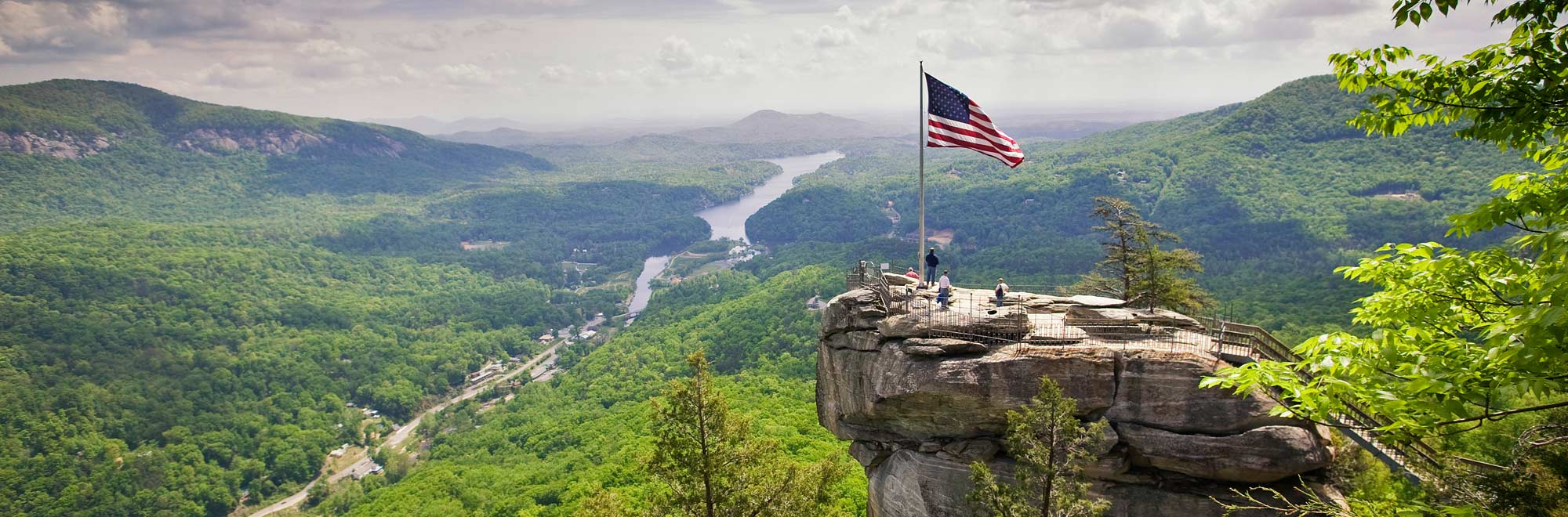
Prayers for all in our North Carolina mountains who have lost home and even life because of Hurricane Helene. Knowing that much has changed and is forever gone, each one of us finds ourselves surveying long held memories in hopes of rationalizing the past while struggling to find new paths forward. For me, I remember numerous Saturday mornings being awakened and loaded into the family automobile well before sun-up. The idea, we kids would sleep while dad enjoyed his favorite time of day as we headed to the mountains in time to have a full sunrise breakfast at the Log Shop overlooking Lake Lure. We then stopped at the gift shops in Chimney Rock and Bat Cave before passing out of Hickory Nut Gorge to take in the Blue Ridge Parkway north beyond Craggy Garden and Mount Mitchell.

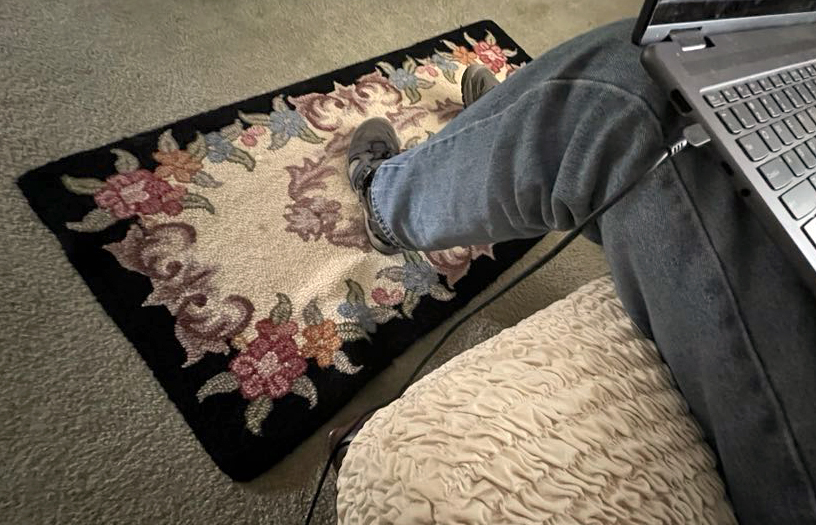
I’ll never forget the relationship mom struck up with an 80+ year old shop keeper at the Manual Crafters’ store in the Village of Bat Cave. My mother, before leaving, purchased a full set of hand-hooked chair cushions for the maple kitchen table which now resides with my nephew in Texas. There was talk of mom visiting another time so she could learn to hook rugs the old way. The plans never matured, the chair cushions have long been gone, but at my feet is a rug hooked from this shop that my brother later gave to mom as a gift.

Beyond the rug and chair cushions, I’ll never forget the old lady’s talk of a flood …I think she said it occurred in 1976. She clinched her muscles out of fear while pointing to her humble abode up the hill and across the road from the shop located along the Upper Rocky Broad River. She recalled the water reaching the foot of the dwelling along with hearing the thunderous sounds of house-sized boulders being rolled by the current. She was fearful for her life. The mountains have seen many bad storms.

It’s the way of the mountains and I’m thankful today that the City of Asheville had the forethought years ago to fill its French Broad / Swannanoa flood plain with new public parks and non-residential enterprises incorporating long lost warehouses and the dilapidated shells of first-generation businesses. It is sad to see the loss of Asheville’s art district albeit many lives have been hopefully saved by the decision. But about the flooding, most worrisome are the many outlying villages located in the dark hollers and river bottoms scattered throughout Appalachia.  Today, more roads are built, more people come to live, and few realize how desperately wild our mountains remain.  I offer prayer in the hope that we can hold to our past while figuring out a safe way going forward.

Our need today to remember and tell the story of the mountains is nothing new. Much the way we remember Hickory Nut Gorge, an anonymous writer glorifies this place as is found in the 1836 Fayetteville Newspaper. He speaks of Chimney Rock and the unfathomable pool.  He compares the land to that where Natty Bumpo once lived, which story is known through the period book, Last of the Mohicans, which movie was filmed in Hickory Nut Gorge. He also memorializes the place as like some Scottish highland born of distant lore. Long before the construction of Lake Lure and the town of Chimney Rock, imagine as a child, your family trekking the rugged gorge in search of some yet foreseen home lying to the west.

Carolina Observer
Fayetteville, N.C.
Found at North Carolina State Archives

22 Sep 1836

COMMUNICATED FOR THE OBSERVER
______________

TYPES OF TRAVEL.
FLIGHT FIRST.

“I pity the man who can travel from Dan to Beersheba and say it is all barren.”

Passing through the wild and rude country of Rutherford, towards the Hickory Nut Gap, the traveler is repaid at night fall for the fatigues of the journey, and the hitherto dreariness of the road by a sudden burst of scenery, as grand as picturesque, as rich as romantic.

Just at the foot of the Mountains he stops for the night: the tall cliffs seem impending over him with almost terrific grandeur, while onward, far onward as the eye can reach, mountain after mountain, ridge after ridge, appear like blue clouds pendant over the low horizon. At his foot the Broad River foams and roars, and dashes his white spray, leaping madly with his clear and cool current, over rock and crag. On the right, apparently at a short distance, a chain of high hills presents an uneven surface of solid rock, bare of vegetation, and presenting on that side a barrier frowning and impassible.

It is a huge pile

—-hideously
“Its shapes are heaped about: rude, bare and high, Gastly and scarr’d, and riv’n!”


On the left, the Chimney Mountain rears its tall summit. This peak is difficult to access, but the view of the Chimney, a shaft of solid rock that shoots up from the base, appearing to have been riven by some freak of Nature from the parent-block, richly repays the labour of the ascent. The shaft seems from the road in size and height to resemble an ordinary chimney, while its top, rising as it were into a point, is capped with dwarfish shrubbery: but when the traveler stays his wearied feet upon the summit of the cliff, and looks upon the chimney now far below him, he is astonished to perceive the points swelled into an area of broad acres, and the dwarfish shrub expanded into a gigantic pine.

A mile or two from this spot, a fine view presents itself of “Fall Creek,” as the natives call it. On the left of the road, and separated by the river, stretches a huge ridge from the loftiest portion of which a creek pours down the rocky side a gushing stream of living water. It is distant a mile from the spot at which you are standing, and must gush over the mountain with great force, for at this distance you can see its torrent leaping madly from point to crag like a thing of life, while the innumerable lesser cascades look like paintings on the rocks. As the sun shines upon the stream, diversifying it with the hues of the Rain-bow, the view is magnificent and splendid.

To a lowlander, this rich mountain scenery presents a picture at which he never tires gazing, and awakens ideas and associations in his mind, to which he has heretofore been a stranger: he is overwhelmed with the vastness of the view –astounded with the appearance of these giant-masses so far greater than his rude imaginings had ever pictured. It was so with the writer. Some years had elapsed since he looked upon the lovely scenery of the Hudson and climbed the green hills of Vermont, wrapping his cloak stoutly about him even under a July sun, and latterly, Haymount and Harrington had been the “ultima thule” of his journeyings. As he looked upon these huge piles of vasty rock –their immeasurable peaks protruding through the very cloud –and thrusting and rearing their heads high above the plains, ambitious aspirants, he could not but mark the mortifying contrast between them, and those aforesaid hills of Harrington and Haymount. The pure purpose and giant intellect, seated afar off in calm serenity, contemning the storm which broke and rolled harmless at their feet: the latter were the fungi of demagoguism, ease of access, whose heads were ever obscured by fogs, and damps, and mists.

The view is not alone of rocky cliffs and granite piles; here the Oak and Chestnut stretch about their immeasurable boughs, and fragrance of Pine assimilate the scenery, in some slight degree to homeward associations. Cedar and Balsam-Fir abound, and everywhere the wild flowers wreath about their varied blossoms to woo and win the eye in these vast forests “and deserts peopled by the storm alone.”

‘Twas a scene for the pencil of a poet, but alas! –the writer was no poet. The calm hour of holy eve has ever a fascination for the senses, but to see sunset in its beauty one must stand near these smoky Mountain-heights, his eye compassing a long view all of grandeur, all of serenity, all of loveliness. It was in the rich twilight of an August evening, that the writer enjoyed this view; the whole heavens seemed bathed in soft tints of mellow splendour, and the Moon was gilding, in the east, the eastern cliffs, as if seeking to rival the dying glories of the setting Sun. Upon one of these cliffs, the rocks had assumed those fantastic shapes, with which the pale light of evening invest the surrounding scenery, and which the eye, aided by the imagination, which that hour, and time always quicken, can twist, and torture into any form or fashion. There seemed to me of some ancient castle — the wall mouldering, and decayed by time –turret and citadel! –here was drawbridge, and the portcullis, with abattis for defense –and the moat, and ditch, and all the paraphernalia of a feudal fortress; the chapel shooting its tall spires to Heaven, typical of the aspirations of its worshippers, the moon-beam playing upon its minarets and towers. Whither my wayward fancy might have led me, and with what storied legends it might have invested this same fortress if had conjured up, is not for me to determine; –I was destined to have a wet-blanket thrown over the ardour of my imaginings in the shape of one of those sudden showers, which, in these high regions, burst from the side of the Mountains, with little of warning, and affording brief time of preparation to those exposed to its peltings. The cloud boiling, as I said from the Mountain side, “in size no bigger than a man’s hand,” but a few minutes had elapsed ere acquiring new volume in its descent, the sky became ever clouded, and the rain poured down in huge and heady torrents inconceivable to one unaccustomed to the climate. Thoroughly drenched, I shrank from my musings and my reveries to shelter. It must have been some such incident that suggested to the Bard those lines,

“Peace to the artist, whose ingenious thought.
“Dayised the weather-house.”–

While upon the subject of the Mountain scenery of this section of North Carolina, let me not omit a rude description of a scenery of this section of North Carolina, let me not omit a rude description of a scenery so picturesque, that a pilgrimage to it alone, would richly repay the toils and fatigues of the lowland wayfarer in reaching it. Distant about a mile from the Chimney Mountain is visible, a succession of grand and beautiful cascades passing description. Between the Chimney and the Rich Mountains, from the summit of their very union, rises and flows down the aperture, Carrick Creek; the stream, crystal in its appearance, bears the name of an aged hunter, once the Natty Bumpo of these parts. Here in the delightful valley awhile did he pitch his tents, and continue his encampment for months together, pursuing his sport in despite of the hostile Cherokee, his unerring rifle making sad havoc, the mean time among the bear and deer, once so prevalent in this region, and still to be found to some extent: here too, from this living and limpid fountain was he wont to quench his thirst. Alas! He too has yielded to the spirit of civilization; smiling fields are everywhere usurping the place of rugged forests, and the rocky battlements of the Mountains frown down upon the Red Warrior no longer, but in his place the descendant of the pale faces from beyond the great waters till the earth and subdue it.

The Creek flows through the yawning chasm, tumbling and roaring, with a strength and rapidity rendered greater at every step of its progress, by its numberless tributary springs and rills. At every twenty yards it descends a natural fall of 30 feet. The attrition of the waters has worn the rock smooth and semi-circular, and so diversified is the granite with streaks of white sand-stone, that one at first view is apt to pronounce it solid mason-work, the labour of hands.

The waters are received into a circular basin, or dark cauldron, forming with a rapid, gurgitating motion, a black maelstrom; the surplus waters boiling over, proceed onward only to encounter fall after fall, cascade after cascade. The roar of the waters may be heard at great distance resembling the rumbling sound of distant thunder. One of these cauldrons is called, par excellence, the Whirlpool, and is of great depth, having never been sounded. It bears some evidence of having been the effect of a pebble, or round quartz rock borne along the current and making its way down the softer granite or sand-stone with the rotary motion derived from the waters. Sinking down onward, far onward, away below, until it may be, it may burst some day upon the astonished vision of some ignorant Symzonian. With what weak, and apparently contemptible agents does it please Providence sometimes to work. What great effects from trivial spring. Had the Roman Poet, who sang the exploits of his pious hero, stood upon the spot, he would have proceeded no farther, but instantly have located his descent to Hades.

The Green family and the Edenton Tea Party

Courtesy of State Archives of North Carolina

It has been many years since the colonists began their separation from the control of Britain. Talk increasingly spread across the landscape as the voices of descent frequently heard during government assemblage grew more loudly. It was during this time of our becoming Americans that such calls for freedom took on the tone of war. In celebration, “in 2026, America will commemorate 250 years since the signing of the Declaration of Independence and the development of a new nation dedicated to “life, liberty, and the pursuit of happiness” .  North Carolinians can be especially proud in that the regulator movement and other political skirmishes within our borders can be rightfully viewed as leading the effort.  And not to be overlooked, in response to the tea act passed by the British Parliament in 1773, a group of 51 women gathered on October 25, 1774, to sign the “Edenton Resolve.”  For what is known also as the Edenton Tea Party, numerous 250-year celebratory remembrances will reverberate across our state during the latter half of October and into early November (see AMERICA 250NC). And thinking about all my cousins and distant relations from long ago, I am amazed to have stumbled upon a connection to our Rocky River home. It’s there where Gideon Green once lived, and he is the one whose Aunt Elizabeth attended the famed down-east tea party.  And if I have read the documents correctly, my Burris family also has a round-a-bout tie to the tea party. I hope to share more on that family later following a related presentation at this year’s Solomon and Judith Burris reunion taking place on October 12. So, when seeing the promos, and historical writings about things most people can only imagine, I ask the reader to realize that you too may have good reason to celebrate America 250.

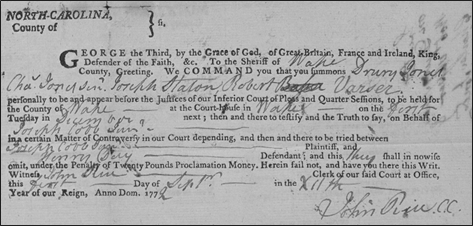
Where do I begin? Before delving into any ancestral struggle for independence, a bit of corrective genealogy is in order. Firstly, Beaufort County History attempts to weave the life of Gideon Green’s son Leonard through a person named Farnifold Green who is credited as the first person to patent land in what is now Beaufort.  A mistaken assumption and instead, I believe Gideon traces back to a person named Leonard whose grandfather, Richard Green Senior, received a 1667 patent near the Virginia line along the Chowan River. And about Gideon Green before arriving to the Rocky River, he is called upon in 1772 Wake County to witness a legal dispute per a civil action paper. Also named on the slip of paper is Joseph Thomas, whose yDNA perfectly matches my Benjamin Thomas family who settled next to and interacted with Gideon in the 1780s Anson County. Not only does Joseph Thomas have known ties to Leonard Green of Wake, in one fell swoop my Thomas family of Anson County is now genetically one with another Thomas family whose descendants spread across Wake, Chatham, Moore, and Lee Counties. Furthermore, my imagination of some preexisting link between the Green family and my Thomas family can now be proven as valid. At the heart of proving this connection is a slip of paper that clearly mentions Gideon Green. Thank-you Gideon for leaving this much-needed piece of evidence in Wake County:

Courtesy of State Archives of North Carolina

Gideon certainly goes back to Leonard Green who appears both in old Montgomery County and in Wake County near the above-mentioned Joseph Thomas.  It is said that Joseph Thomas hails from Bertie County, but hesitantly, I wonder if another path carried him alongside Leonard Green and others by way of a migratory stop in Edgecombe County. This is not the time for that discussion.

Back to the Green family, on 13 Sep 1742 in Edgecombe County, Richard Green penned a Last Will and Testament (LW&T) in which he claims Chowan County to be his home. Richard gives land individually to his sons before mentioning them collectively: “I also give to my five sons Richard Green, William Green, Thomas Green, Lonard Green, Jacob Green, my wife’s land for which their own need.”  One would instantly think that Richard had five sons. And of this number, each is bequeathed land such that the descriptions provide helpful information for understanding the family movement back to the original 1660s patent. However, a son is missing as one other is called out separately:

“Item: I give and bequeath to my son John Green twenty shillings to be raised
out of my estate.”

While each son was given land, Richard Green bequeathed twenty shillings to his son John. Such is usually the case when out of fairness, an heir already held ownership or was somehow in possession of real property. And while most of the sons drifted west, we now know that John remained down east.

Much more could be said about the family of Gideon and his probable father Leonard Green though the subject of this post involves the lesser-mentioned John Green, who happens to be Gideon Green’s uncle. It’s a rare treat to be able to share information about down-east kinfolk as relates to the dirt farmers who settled along the Rocky River.  Records indicate that John Green remained along the Chowan River where less than a month before appearing in his father’s LW&T, he purchased from William Bly [Blythe] a 150-acre piece of land on “Indian Branch beginning at the mouth of a branch running out of Catherine Creek pocoson [swamp].” Situated near land owned by the ailing Richard Green, the acquisition possibly precluded John’s need to receive land through his father’s LW&T. Furthermore, per the Native American Project, Roberta Estes shares the following narrative concerning the nearby Chowanoke Indians:

“The Chowan Reservation originally lay in what is now Gates County, on the banks of Catherine’s Creek and Bennet’s Creek. It seems to have consisted mainly of swamp land, roughly 17 square miles in 1729. The land was sold off steadily through the 1700’s until by 1790 the tribe had been reduced to nothing.”

John continued to own land along the Virginia road though he quickly moved a bit south along it to where he is found in the governmental town of Edenton. Moving forward to the 1760s, court and deed records identify John Green as purchasing numerous lots in Edenton. Identifying him as a carpenter, one such document calls out three houses 36’ x 18’ in size. And from North Carolina Architects and Builders, John was called upon to make repairs to the courthouse.  And for the historic St Paul’s Episcopal Church, “John Green accomplished the joinery work of putting up the pulpit (since lost).”

It is believed John Green married Elizabeth Branch, the daughter of William and Elizabeth Branch. A widow, John’s wife married first to Edward Underhill, who died circa 1757. John’s Last Will and Testament (LW&T) was penned in Nov 1779 in which he identifies himself as “Inn Keeper.” His wife Elizabeth is given the liberty to choose from household items. And noteworthy, the will is witnessed by William Hoskins.

Charged with the task “to digitally publish exhibits on various special topics,” the North Carolina Office of Archives and History created MOSAICNC where can be found the following concerning John Green. He was “a staunch advocate for the Patriot cause during the American Revolution, Green served as a member of the Edenton Committee of Safety in 1775.” The bio includes his signing of “a bond promising that Thomas Hoskins would appear before the Edenton District Superior Court in May 1778.” A year before John Green’s LW&T was written, the said Thomas Hoskins came to court to declare and “bear faithful and true Allegiance to the State of North Carolina, and will truly Endeavour to Support, Maintain, and Defend the independent Government thereof, against George the third, King of Great Britain, and his Successor.”  Note that Thomas Hoskins’ brother William witnessed John Green’s LW&T.

If the foregoing is not enough to raise the brows of Green family rooted along the Rocky River, note that Solomon Burris’ mother may be Thomas Hoskins’ sister.  Not only did our Burris and Green kinfolk once know and likely spend time with each other back in Edenton, in round-a-bout ways, they also were there for the famed tea party.  More on the Burris connection at the upcoming reunion. But, for now, four years before assuring that Thomas Hoskins would appear in court to declare his allegiance, Gideon’s aunt Elizabeth joined a group of women to voice their support for the American cause against unfair taxation. Considered the first such gathering of women in America, Mrs. Penelope Barker organized the meeting at the home of Mrs. Elizabeth King at which time resolves were drawn to boycott English tea and cloth.

Proudly referred by North Carolinians as the Edenton Tea Party, a message dated 16 Jan 1775 in the Morning Chronicle and London Advertiser provides the following account along with the only authentic list of signers.

Extract of a letter from North Carolina, Oct. 27:

The Provincial Deputies of North Carolina having resolvd not to drink any more tea, nor wear any more British cloth, &c. many ladies of this Province have determined to give a memorable proof of their patriotism, and have accordingly entered into the following honourable and spirited association. I send it to you, to shew your fair countrywomen, how zealously and faithfully American ladies follow the laudable example of their husbands, and what opposition your Ministers may expect to receive from a people thus firmly united against them.

RESOLVED

As we cannot be indifferent on any occasion that appears nearly to affect the peace and happiness of our country, and as it has thought necessary, for the public good, to enter into several particular resolves by a meeting of Members deputed from the whole Province, it is a duty which we owe, not only to our near and dear connections who have concurred in them, but to ourselves who are essentially interested in their welfare, to do everything as far as lies in our power to testify our sincere adherence to the same; and we do therefore accordingly subscribe this paper, as a witness of our fixed intention and solemn determination to do so.

Abagail Charlton         Mary Blount

F. Johnstone             Elizabeth Creacy

Margaret Cathcart       Elizabeth Patterson

Anne Johnstone          Jane Wellwood

Margaret Pearson        Mary Woolard

Penelope Dawson       Sarah Beasley

Jean Blair                    Susannah Vail

Grace Clayton             Elizabeth Vail

Frances Hall                Elizabeth Vail

Mary Jones                  Mary Creacy

Anne Hall                    Mary Creacy

Rebecca Bondfield     Ruth Benbury

Sarah Littlejohn          Sarah Howcott

Penelope Barker          Sarah Hoskins

Elizabeth P. Ormond     Mary Littledle

M. Payne                      Sarah Valentine

Elizabeth Johnston      Elizabeth Crickett

Mary Bonner               Elizabeth Green

Lydia Bonner             Mary Ramsay

Sarah Howe                Anne Horniblow

Lydia Bennet             Mary Hunter

Marion Wells               Tresia Cunningham

Anne Anderson           Elizabeth Roberts

Sarah Mathews           Elizabeth Roberts

Anne Haughton          Elizabeth Roberts

Elizabeth Beasly

Of all the stories from which to anchor one’s heritage, I find it remarkable that my simple family of farmers from western North Carolina can be remotely connected to such people and such an event. Does one raise a cup of tea in memory, or instead, should we withhold? Never placed in the position to even consider best etiquette, there’s lots to consider as October turns to November.

Rocky River: So Much More to Learn

Most of us rooted in southwest Stanly County are aware of the genealogies of Drury Morgan and his neighbor William Brooks. There are also others such as William Gurley and John Austin who may have tipped their hats at one another from their fields across the river. But what was life genuinely like for these men who we hold as being among the first to settle the Rocky River? In answering this question, an eager genealogy enthusiast might find satisfaction in mapping a path through the status quo, being little more than a regurgitation of genealogies frequently plastered across the internet. There are also cousins who dig more deeply to reveal layers of family stories hidden within fragmented legal documents. Searching hard to build new narratives does not guarantee some deep and provable understanding will be found.  Instead, though the effort may reveal new possibilities, new finds ultimately plateau leading to new questions we may never answer. Of this sort of thing, I enjoy looking deeply and I hope you realize that the information offered here didn’t happen without struggle. Here are some bits and pieces I hope will help you in your exploration to learn more about your family.

In Dec 1779, Goin Morgan made entry of 250 acres “lying on Rocky River. The survey reads: “beginning below the fish trap: below the mouth of Island Creek including Benjamin Bowlings improvement” (see A). There’s a problem with this 1700s legal description as it can be proven that the land is actually located downstream from Rockhole Creek and therefore is situated upstream from Island Creek, not below it. And beyond anything related to the Morgan family and their neighbors, who was this person named Benjamin Bowlings? I cannot help but think he is somehow related to a fellow of same name whose descendants struggle online to understand his movement through our North Carolina Piedmont. I would love to hear from anyone descending from this Benjamin Bowling [Bolling].

Some 20 years later, in 1798, the 250-acre tract was formally surveyed and patented not to Goin Morgan, but instead to his heirs. Having first acquired land far away on the east side of the Yadkin River, Goin was dead at the time of issuance. And then, four years following this patent to the heirs, Goin’s son Jonathan received a grant for 300 acres (see B) wrapping around the 250-acre tract. Jonathan’s land is legally described as adjoining John Morgan’s property to the west and William Brooks’ to the east. But how did John Morgan acquire the land mentioned in this case? Note also that the family built a mill near the river along with the establishment of a ford or river crossing downstream from the mill. Later, in August of 1843, shortly after the formation of Stanly County, the fledgling court ordered:

“twelve free holders to lay off a road from Morgan’s ford on Rocky River the best and most convenient way to intersect the old road at the ford of Island Creek that leads from the Big Lick to the Widow Little’s.”

The widow Little initially lived east of present-day Rene Ford Road, though later, her home was closer, I believe, to Hwy 200. The original route from Morgan’s Ford might connect to and align with the path of today’s Buster Road. Furthermore, Morgan Mill Road crosses the heart of Goin Morgan’s 250 acres where the historic Morgan Chapel stands in quiet testament of a lost era punctuated by a little-known effort to serve the spiritual needs of Germanic Lutherans flowing from Cabarrus County …likely in search of gold. Also, Drury Morgan is listed as an elder at nearby Flat rock Lutheran Church per an 1840 membership report. More on that in a future post, but wow, can you imagine the stories that the hallowed grounds at Morgan Chapel could tell?

To the west of Jonathan Morgan’s large tract lies two properties having origins unlike any recollected by most of us rooted in southwest Stanly County. In November of 1782, a time when preliminary articles of peace ending the American Revolution were signed, an entry of land (see C) later issued to West Gurley reads:

Courtesy of State Archives of North Carolina

“for William Brooks, one hundred acres of land for West Gurley opposite the mouth of Grassy Creek on the N. side including the plantation that Goin Morgan bought of Phereby Gurley.”

Grassy Creek rises in Union County and flows north until emptying into Rocky River near Hwy 200.  So, the land in question is situated to the north of Rocky River, in present-day Stanly County, near the crossing at Hwy 200.  But of importance, who is West Gurley, and for that matter, who is Phereby Gurley as spelled out in this land grant entry? Note that the names of women appear infrequently on Secretary of State land records from this early time. Much needs to be said about West and Phereby Gurley, but for now I need to introduce yet another person whose name is Jonas Phillips. The son of Reuben Clements Phillips of Rowan County and earlier of Maryland, Jonas made entry of one hundred acres joining both West Gurley’s survey along with “his own old line in the fork of Rock Hole Creek and Rocky River.”  We know from this wording that Jonas Phillips owned additional land in the vicinity if not encompassing a part of Goin Morgan’s land. The 1798 survey (see D) of Phillips’ entry calls out Carson & Moore’s land to the north and confirms West Gurley’s land to the south.

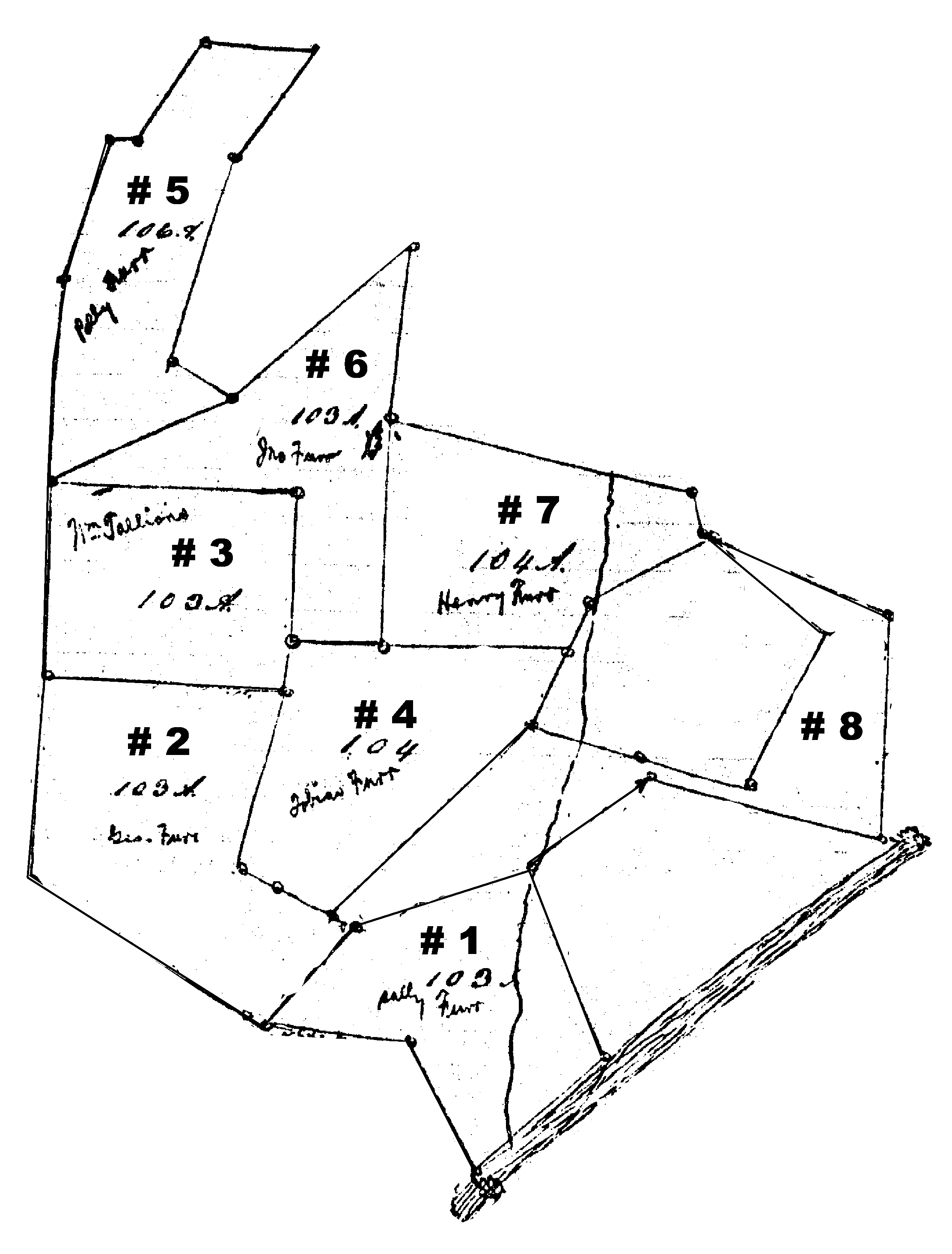
Jonathan Morgan’s son Drury received a grant for sixty acres (see E) in 1837. Adjoining this land is the tract granted to Jonas Phillips. Later, Jonas’ land is called out in Drury’s 1837 patent as being owned by John Furror (Furr). So, for some reason, John Furr of Cabarrus moved to or at least acquired land in present day Stanly County …again, think gold. The effort to establish a Lutheran church at Morgan’s certainly served the needs of people like John Furr. And note, John Furr’s land below present-day Stanfield is filed not in the annals of Stanly County, but instead, the large and wonderfully drawn division plat appears in the 1834 estate of John Furr found in the Cabarrus County deed book. The division (Cabarrus 14-139) does not mention or otherwise indicate in any way that the land is situated in what would soon become Stanly County. Furthermore, it is in this event that we can begin to anchor the movement of John’s children across the river into lands in present-day Stanly County. For the benefit of researchers, John Furr’s land was distributed as follows:

Lot 1: Sally Furr   Lot 2: George Furr   Lot 3: William Stallings   Lot 4: Jacob Furr
Lot 5: Polly Furr   Lot 6: John Furr   Lot 7: Henry Furr   Lot 8: Tobias Furr

Back to Phereby Gurley. According to the declaration made in the previously mentioned land grant warrant to West Gurley, at the time of the 1782 date, Phereby was surely of legal age to rightfully own the “plantation” through purchase or possibly as beneficiary by dower or heir following the death of a relative. And beyond the obscure notation, a little bit of searching adds yet another twist as on 12 Jul 1778, Jonas Phillips and his brother John Phillips filed a marriage bond in Rowan County on behalf of Jonas’ marriage to none other than “Phirlebe Gurley.” A coincidence? …no way! Of note, Spruce Macay, being an up-and-coming attorney and mentor to young Andrew Jackson, signed the bond as a witness. So, it appears Jonas lived beside Phirlebe [Phereby] Gurley, who owned her own plantation and who would later marry the said Jonas Phillips.
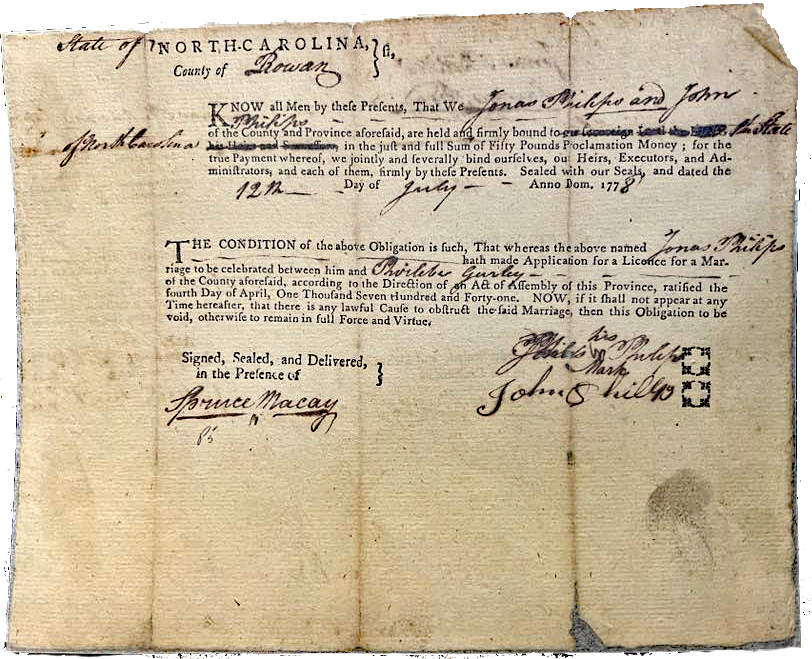
Courtesy of State Archives of North Carolina

About the Gurley family, the term conflation truly applies as is the case with many North Carolina families of this early time.  Meaning a “merging of two or more sets of information, texts, ideas, etc. into one,” attribution of early records representing a family may not be proven and therefore can easily lead to a seriously mixed-up understanding of ancestry. Most notable of the Gurley family who settled along the Rocky River happened to be brothers William (referred to in this post as William II) and Jacob Gurley who came from Johnston County. Records for multiple members of their extended family can be found in abundance spanning the counties of Johnston, Wayne, Duplin, Dobbs, Sampson, Edgecombe, and Bertie. With few of the documents clearly stating familial relations, how can we truly separate and attribute lineages from such a broad hodgepodge of possibilities?

As for Wiliam Gurley II, he settled on the south bank of Rocky River between its waters and Richardson Creek. This William wrote his last will and testament (LW&T) in 1804, in which he bequeathed to daughter Jean:

“one cow and calf also two three year old hogs spaid sows and barrows belonging to the Lauhon gang, also two hundred and fifty acres of land on the watery branch to be equally divided between her three boys Alexander Pool and William Pool and Nathan Pool …”

Execution of the will must not have gone to plan as a court ordered distribution of the estate of William Gurley II occurred some eleven years later. At that time, in 1815, the above-mentioned 250 acres bequeathed to Jean and her sons (all having at that time the last name of Pool) was split such that Jean’s brother James Gurley received the northern half of the property. Maybe the brother and sister got along, “gee-hawed” as my elders might say. Furthermore, instead of William’s daughter Jean appearing in division, Sander Pool is called out as recipient of the land bequeathed to Willaim’s daughter Jean. Sander is surely Jean Gurley’s husband, and he rightfully took ownership of the land on behalf of his spouse as was legally customary for the time.  Maybe the bequeath by William Gurley II to his daughter along with his mention of her sons appearing in the LW&T was done so to make no doubt that he intended for the land to pass down to his Pool grandchildren.

Years later, in 1821, the above-mentioned Nathan Pool, then living in Kentucky, released his rights to the William Gurley II estate to “Lydia Pool” …no mention at that time of Sander. Also, William Pool of North Carolina followed suit with a release of rights to Lydia in 1826. Who is this Lydia person?  Having no proof, I believe she was their mother, who was born Lydia Jean Gurley, the daughter of William II, and therefore the wife of Sander Pool.

The families of Gurley and Pool are deeply enmeshed as in the 1780s a person named Middleton Pool sold to William Gurley II two tracts of land on the Rocky River. How does Middleton relate to Sander? And, back in 1764 Johnston County, North Carolina, another instance of a person named William Gurley sold land on Moccasin Swamp to Alexander Pool. The land in question was called out as originally being “granted to Wm. Gurley Sr, bearing date 15th March 1756” and note that the deed was witnessed by John Austin and a person named Nathaniel [Nathan] Gurley. Nathan is mentioned as “son” in his father John Gurley’s LW&T probated in 1760. The exact relation between John and William Gurley II is not known.

Nathan Gurley died circa 1777 in Johnston County at which time his will mentions wife Anna, sons Arthur and Robert, and daughters Elizabeth and Fereby. Nathan appointed his “friend William Gurley Senr” to be executor and the will was witnessed by Wiliam Gurley Junior. Who are these people? Note that the father of William Gurley II is William Gurley I, who, from court minutes, died circa 1760.  Therefore, the person referred to in this post as William Gurley I is likely “William Sr.”  who patented land in 1756 though he cannot be the person named William Gurley who sold the same land to Alexander Pool in 1764. Neither can he be William Gurley Senr who witnessed the will of Nathan Gurley in 1777. Again, since the parentage of this William Gurley is not proven, he could just as easily be William Gurley II or another William, possibly the known son of John and therefore the brother of Nathan. Note that Nathan’s wife Anna [Anne] Gurley received a patent for land in Johnston County following the death of her husband. The land belonging to Anna Gurley passed to someone else and then to Needham Whitley who is acknowledged as a member of the large Whitley family who settled along Rocky River. Birds of a feather?

The wife of William Gurley I is named Mary and most believe her maiden name to be Mary West. Mary lived until 1792 when her LW&T names children William [II], Jacob, Isom [Isham], Rebeckah, Lida Pool, Mary Borwick, John, and Patty.  Here we see the Pool name again, this time in a document involving the Gurley family a generation earlier. Note that the LW&T of Mary Gurley was witnessed by Needham Whitley, Patty (x) Gurley, and Isom (x) Gurley.

Beyond Wiliam II and Jacob Gurley, did others from the extended family move to the Rocky River region  …an idea few have exercised? Per a pension request raised while living in 1832 Pickens County, Alabama, it is known that [Isom] Isham Gurley served in the Revolutionary War. His request was denied because he did not serve the minimum period required to receive compensation. However, the formal request provides the following:

“Since the Revolutionary War, he (Isham) removed to Anson County, North Carolina, where he resided about ten years, thence to Buncombe in the same state, thence to Pendleton, South Carolina, thence to Pickens County in the State of Alabama …”

Isham indeed lived in Anson where in 1804 the Secretary of State Land Grant office assigned him a patent of land on the Flag Fork of Watery Branch. The land was originally entered in 1796 by Michael Austin.  James Gurley and John Lawhon, respectively the son and son-in-law of Isham’s probable brother William Gurley II served as chain bearers for the survey. Another brother, Jacob Gurley, sold two patented tracts in Johnston County before moving to Anson County.

There is a hint of deeper family interaction in the assignment of Michael Austin’s land grant to Isham Gurley.  Also suffering from the dangerous temptation of conflation, Michael’s father is believed to be John Austin, who happened to marry Rebeckah Gurley back in Johnston County. Most of John Austin’s children, Richard, Bryant, Michael, John, Drury, Jacob, and Jonathan moved to the Rocky River region where their descendants make up the vast majority of those today carrying the Austin surname. Some moved to Lincoln County, Tennessee before spreading into Alabama and beyond. But who is John’s wife who genealogists attribute as being Rebeckah Gurley?  Could she be the sister of Isham, Jacob and William Gurley II as appear in their mother’s 1792 LW&T?  That’s the easy way to declare her ancestry albeit Rebeckah could also fit elsewhere within the larger Gurley family. If we only knew this one thing.

As for William Gurley II, the title history for lands he lived on prior to moving to Anson County is slim and confusing at best. It’s evident that William, son of John and Anna Gurley purchased land from Richard Pilkington lying on the Moccasin Swamp of the Neuse River in 1777. The idea makes sense as his mother Anna witnessed the deed.  Yet, the other witness to this transaction happened to be John (x) Barwick, who must be the brother-in-law of the said William Gurley II, per the LW&T of Mary Gurley.

So, William II, who came to Anson County with his brother Jacob, is named after his father who is believed by some to have married Mary West. Furthermore, tradition holds that a person called West Gurley, who received a grant near the Morgan lands on Rocky River, is named for Mary West Gurley’s maternal ancestry.

Adding some flavor to the mix, before moving from Johnston to Anson County, North Carolina, in 1776, William Gurley II is possibly the person who sold 100 acres in Duplin County to James McClenny, whose extended family also became a prominent fixture in the annals of Anson County. This deed was witnessed by Thomas Strickland, Isom (Isham) Gurley (possibly the brother of William I), and Lewis Gurley (which makes one wonder).

In 1764, William Gurley, I believe William [II], sold land on Moccasin Swamp in Johnston County to Alexander Pool. The deed was witnessed by John Austin and William’s probable cousin Nathaniel Gurley.  Nathan died circa 1777 at which time he appointed “his friend William Gurley Senr” to execute his last will and testament, which, at the time, leads one to think the will was signed by William Gurley II …but other possibilities exist. All I need is to know just one thing! Nathan’s LW&T mentions his daughter Fereby. Could Fereby have traveled to Anson County with her uncle and cousins’ family? Could she be the person mentioned in West Gurley’s land entry?  Did she marry Jonas Phillips? Note that William Gurley II also had a daughter named Fereby, though she would surely be too young to be the same person mentioned in West Gurley’s land entry on Rocky River. And rereading West Gurley’s entry more closely, I ask again, how should we interpret the claim that the said Wests’ entry included the plantation that Going Morgan bought of Phereby Gurley?

Again, who is West Gurley, and for that matter, exactly who is Phereby Gurley?  Though no proof exists, I ponder that he is likely the son of William Gurley I who died in 1760 Johnston County. West Gurley is believed to be named after his mother’s family and regardless, he settled briefly on land near the brothers Jacob and William Gurley II on the Rocky River. West is not mentioned in his believed mother Mary Gurley’s last will and testament filed in 1792 Johnston County, nor any other relevant document sourced in North Carolina. However, from Mary’s will and other documents in Johnston County, we have confirmed family ties to the Austin and Pool families whose relations remain intact through the Rocky River region, stretching all the way to Alabama. West Gurley moved to South Carolina by the mid-1790s where family histories indicate he married a person named none other than Mary Fereby. Another Phereby! …this time a maiden last name. Quite curious, all of this makes one pause upon seeing the name Phereby in conflicting historical documents including mention in the 1779 Montgomery County land warrant.

 Additional connections to the families already discussed can be found a short bit downstream on the Rocky River at a creek once called Stillwater Creek, now Coldwater Creek. Beyond Island Creek and rising in Oakboro (old Big Lick), Coldwater Creek flows south to Rocky River. It is somewhere in this area where, in 1790, Sander Pool patented 40 acres lying on both sides of the creek (right). I have yet to precisely locate the granted land though I believe it surely must be somewhere between the river and Oakboro. Note that William Gurley and James Gurley served as chain bearers for Sander Pool’s survey. One normally thinks of William Gurley when studying land and people who settled on the south side of Rocky River.

Entered eleven years earlier, in 1779, and issued in 1785, Alexander Pool Junior received a nearby patent for 94 acres (see F below), being the plantation that he lives on joining William Phillips on the north side of Rocky River. Note that Sander Pool and James Gurley served as chain bearers for this patent issued in 1790 Montgomery County.   Likely too old to be the son of Sander and Lydia Jean Pool, could this be the same Alexander Pool who Wiliam Gurley I sold land to in 1764 Johnston County? Or could this person named Alexander be he who married Lydia, the possible sister of William Gurley II per their mother Mary’s LW&T? The exact location of Alexander Pool’s patent is difficult to determine though the site reveals itself per its mating to other land grants.

As already stated, at the time of survey, Alexander’s land adjoined that belonging to William Phillips who I believe acquired his land in part from John McCulloh. More later about William Phillips.
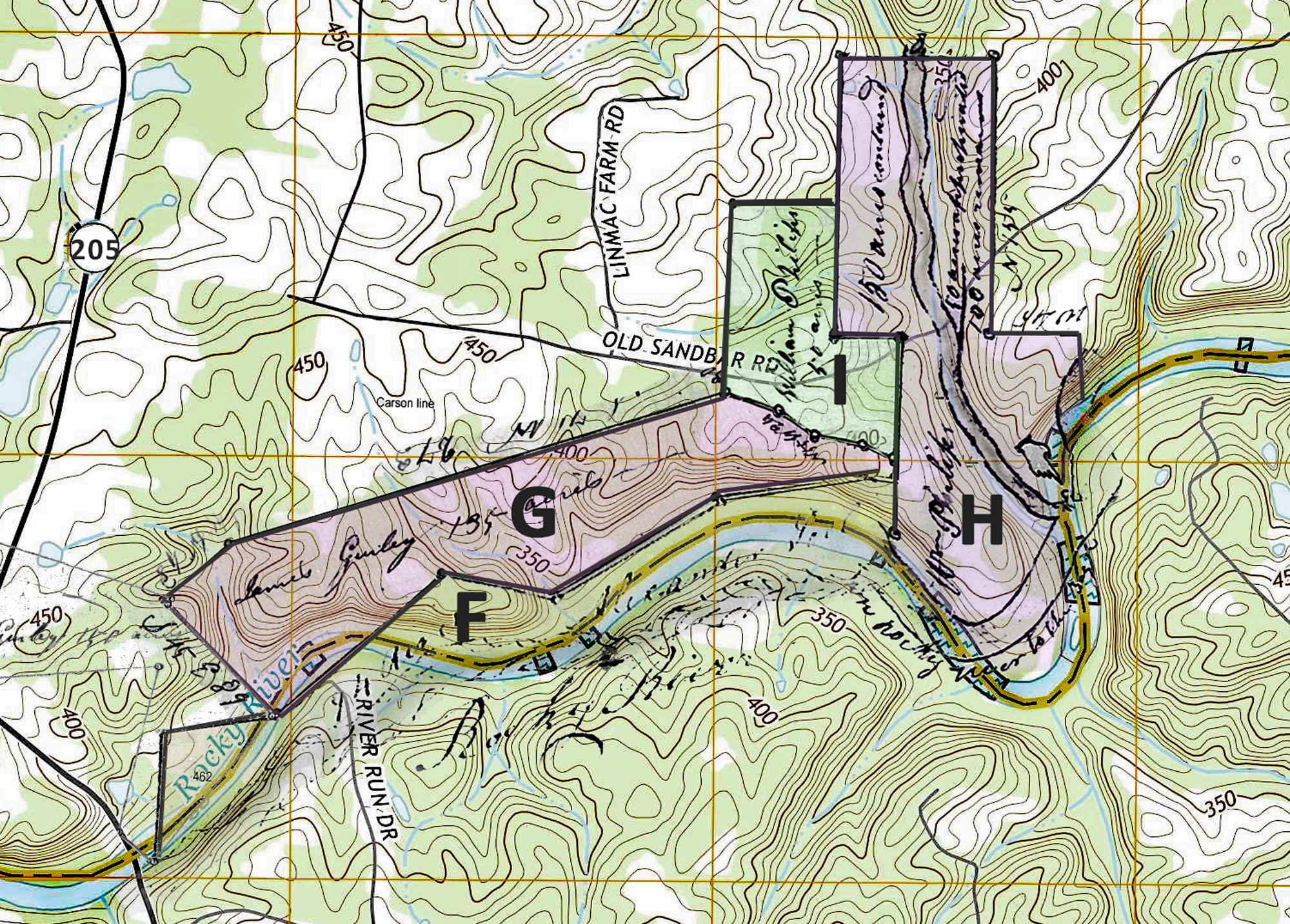
In 1804 James Gurley entered 135 acres (see G) called out as adjoining his own land to the west and south. And, a year earlier, James patented 150 acres to the west adjoining Austin and Brooks (see G2). Additionally, the 135-acre tract mates perfectly with Poole’s 94-acre tract indicating it had been purchased by the said Gurley from Alexander Poole, Junior. And again, there is also mention of William Phillips’ land adjoining to the east where it mates perfectly with a 50-acres tract (see I) issued to William Phillips, who is believed to be the brother of Jonas Phillips who married Pherile Gurley. Remember, William Phillips and William Pool served as chain bearers for the land issued to Alexander Pool, Junior. And note that James Gurley and William Phillip’s probable brother Jesse Phillips served as chain bearers on behalf of William Phillips’ 50-acre acquisition.

About the Phillips family, from earlier in Maryland, William and Jonas moved with their father Reuben Clement Phillips to the vicinity of Second Buffalo Creek in Rowan County. I have not sought to verify the family’s ancestry, although Revolutionary War pension records document his relinquishment of rights to future claims. As appears in an Aug 2000 Genforum inquiry,

“In 1776, William Phillips served under Colonel Locke and General Rutherford in a retaliatory strike against the Cherokees at Hiway in Tennessee. General Rutherford led 1900 men across the mountains. The casualties were buried at Third Creek Church. On February 9, 1778, William Phillips filed for 100 acres of land on the headwaters of Dutch Second Creek next to Andrew Holtshouser, Wendle Miller, and Jesse Phillips in Rowan County North Carolina.”

Little narrative exists on the Phillips family stay in present-day Stanly County. However, William Phillips’ declaration occurring in Overton County, Tennessee, reads as follows:

“In a filing dated January 12, 1841, the veteran stated that he lived in Montgomery County North Carolina before moving to Overton County Tennessee 20 years past.”

At this point we are I now need to discuss William Phillips’ 100-acre patent; the issuance is actually based on the combination of two 50-acre warrants bearing original file numbers 970 and 971 as follows:

No. Carolina}                                                                                                                                                   No. 970
Montgomery To the Surveyor of sd. County Greeting. You are hereby required to layoff & survey according to law for William Phillips a tract or parcel of land containing 50 acres on the waters of Rocky River on Still Water Creek above Wm. Phillips’ improvement. Observe the directions of the act of assembly made & provided in such case given from under my hand at office this 18 day of Nov. 1794                                                             Jno Crump EJ


No. Carolina}                                                                                                                                                   No. 971
Montgomery To the Surveyor of sd. County Greeting. You are hereby required to layoff &survey according to law for William Phillips a tract or parcel of land containing 50 acres joining Aex’r Pool’s line in the fork of Still Water Creek the waters of Rocky River & joining Wm Phillips, including an improvement held by the sd. William Phillips. Observe the directions of the act of assembly made & provided in such case given from under my hand at office this 18 day of Nov. 1794                                                             Jno Crump EJ

The survey plat (below) defined as both 100 and150 acres (green) occurred a year later at which time the two warrants are called out while the plat or legal drawing indicates “50 acres appropriated – 100 acres remains” (red). The discrepancies are made clear by the surveyor: “after deducting 50 acres out of the above plan which is held by the said Phillips” (blue).  In other words, this survey is a bit atypical in form because it encompasses land outside of the entry.

Appearing in another warrant and the resulting issuance of land on Still Water Creek, 14 years before William Phillips patent, a person named David Matheny also received a warrant for 50-acres “on Still Water of Rocky River on No. side of sd. Creek including his improvement.” The survey and documents call out “Daniel” Matheny, not David. The survey plat incorporates similar metes and bounds, matching perfectly the lie of land on the southern end of the larger tract later patented to William Phillips. It is in that observation I believe William Phillips’ “50 acres appropriated” was initially granted to David or Daniel Matheny. Furthermore, and of interest, the chain bearers for Daniel Matheny’s survey happen to be Daniel Matheny and a person named Thomas Sims. Note that a family member is named Simms Matheny and unsubstantiated history indicates they may have resided on Richardson Creek in Anson County at least through the early 1800s.

The above relates to much of the lower half of William Phillips grant incorporating 50 acres earlier patented to Daniel or David Matheny.  But there is more. The legal description for the Matheny survey describes the final and southern-most line of that survey as running from a “hickory in McCulloh’s line then east 90 poles with McCulloch’s line to the beginning.”  The N/S measurement for the western boundary of the lower half of William Phillip’s 150-acre patent is simply too short unless land below Daniel Matheny’s entry (pink) is considered.

Beyond mention and though owning numerous small tracts nearby, there appears to be no surviving document supporting this land as once owned by “McCulloch.”  That being stated, I have no doubt that the land in question likely belonged at one time to Henry Eustus McCulloch, the son, surveyor, attorney, and agent of Henry McCulloch who, as a speculator, brilliantly acquired 1.2-million-acres through dealings involving James Huey and Murray Crymble. As alluded to in Matheny’s entry, the edited plat (right) incorporates the ideas presented. The pink shaded area belonged to McCulloh. Daniel Matheny received the patent for the green shaded area while the survey for William Phillips’ two warrants incorporated it all.

The mouth of Coldwater Creek is known, a given.  Would be interesting now to look at the present-day Stanly County GIS map from which one could trace the land back in time to the founding of Stanly County.  The jump back at that point to origin may remain untold as defined by the gap in available records. However, as for William and his brothers Jesse and Jonas Phillips, and for the Gurley, Pool, Morgan and Brooks family, the above adds something new to what is known about the community where they once lived. In conclusion, there is much to learn in piecing together land records. This post has attempted to outline bits and pieces concerning ownership and how life can be breathed into little known stories of first settlers and how they interacted with one another.
Ananias [Nias] Thomas + Sarah [Ross?]

It’s been on my mind since the late 90s when I came across something a bit irregular while reading through the original Union County tax books housed at State Archives of North Carolina. Like most county records once stretching the capabilities of County Courthouses across our state, Union County’s original tax lists were moved to the centralized repository in Raleigh where they receive a higher degree of safety. And about the source in general, tax lists document all legal landholders for a given year inclusive of how many acres each person owned along with the total value of each said tract of land.  Such tax lists are considered by researchers to be valuable as prime resources due to the information that is collected and recorded by a legally responsible official for use in determining how much tax is to be charged.  And from a genealogical standpoint, whether the information is used to track people as they come of age or die, or to track changes in wealth through time, county tax lists provide family historians with snapshots in time as well as a better understanding of trends regarding how people faired in comparison to their neighbors.

Going back to the early 90s when I first began my quest to learn more about my heritage, and at first poring through handwritten family group sheets shared from ring binders compiled by others, it became known to me that my third great grandfather Ananias Thomas married a person named Sarah Ross. However, in time I found no record substantiating the claim.  Furthermore, from comments made on the old Genforum genealogical forum, I learned that many in the Ross family were adamant that Ananias could not be the husband of the only known Sarah Ross.  Yes, we have her grave marker identifying her name as “Sarah Thomas.” We also have her loose estate papers which include a document listing every single one of her many surviving children and grandchildren. However, I believe there is no specific document or lore treasured by the Ross family we can put to work to synch this wishful belief.  And that’s only half of the problem. Note that the image of the tax list (top of page) names Headley Thomas, truly an unusual name with origin maybe helpful in resolving this dilemma. Born circa 1815, the son of Ananias and wife Sarah Thomas, who was Headley Thomas named for?

Living between Gourdvine and old Negrohead (now Salem Creek), my Thomas family neighbor happened to be Francis Coburn (1740-1813) who appears earlier in Martin County NC.  Francis married Lydia Ross, and they had son Headley Coburn who was born circa 1765. Some say that Lydia’s maiden name may be Headly. Fifty years older than Headly Thomas, could Headly Coburn be his namesake?

There is also Col. Headley Polk (1812-1907) who grew up in the neighborhood and whose father William Shelby Polk is said to have married Winnefred Colburn, a daughter of the aforementioned Headley Coburn. Headley Polk moved with family to Tennessee before settling in Texas.

Please realize that at this point I am not trying to prove the ancestry of Headly Thomas, albeit Headley Coburn and Headley Polk must play into how my family’s lore came to be. And at some point, long before I took up the craft of genealogy, some unknown person mapped their thoughts on the old tax list, likely unbeknownst to the clerk of court while the book of tax lists was housed in the Union County Courthouse (not at all a good thing!).  Also listed is Ola, or Alice Thomas, whose husband David is Headley’s brother and therefore my second great grandmother.  And of the notation concerning Charity Thomas, she is the widow of Ezekiel Thomas who is Ananias Thomas’ brother. Ezekiel owned land on the north side of Richardson Creek giving reason for his wife to be the namesake of the crossing called “Charity Ford.” It is said the old Thomas burying ground was once located nearby on the northside of the stream.  Charity married second to Peoples Hasty and Ezekiel’s son Jonathan (born to a first wife) soon after left for Cherokee County, Alabama where also lived members of the Coburn family.

It would be very easy to grab the name Sarah Ross and make her my own.  However, the details simply do not make the case. Maybe it is time to look again as new tools including DNA and the digitization of documentation might be brought to bear.

Vikings in the Rear-View Mirror

Hjörleifshöfði, Iceland

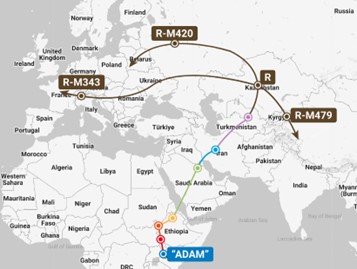
I grew up a happy towheaded young’un with hair indicative of some Northern European descent.  My view concerning ethnicity began to change as my hair browned with age. Being a THOMAS with believed heritage originating in Wales, the advent of yDNA research through FamilytreeDNA.com led to beginnings much deeper in time (see Adam, right).   Note that yDNA research traces son to father ancestry ever-so-deep into time without the dilemma of genetic halving encountered when using autosomal testing products such as can be purchased through Ancestry.com.

Chromosomally, yDNA traces a person’s direct paternal line deep into time while autosomal testing cannot accurately reach further than say 7-8 generations. Sadly, and unlike as would be the case with more recent points of entries in places like Galveston or Ellis Island, the tool begins to fail many of those of us rooted in early North Carolina roughly at the time our ancestors arrived in this new world. Hence, the tool fails many North Carolinians during a time beyond what can be rightfully studied through the simple autosomal tools purchased commercially.  But autosomal testing is both a great tool for discovering more recent cousins along with finding clues as to the widespread origins of all the different genetic ethnicities making up who we are today.  And while yDNA traces the paternal lineage deep into time, improved autosomal studies give us a greater understanding of communities and how people recently migrated together across the landscape. Again though, it’s sad for this family historian that such tools once again fail to pick up on the generations of family and friends as they entered our state from Virginia circa 1700. It’s a tough reality to imagine what atDNA could do for my family research if it were accurate for a mere two or three more generations back in time.

With tool talk now out of the way, I’d like to share a bit on a recent vacation along with how that experience has impacted the way I see my family. You see, the recent opening of a flight hub out of Raleigh-Durham in North Carolina has enabled me and family to explore the remote reaches of Iceland. Also, my sister-in-law, who is born Danish, has always been proud of her Viking heritage and has told me I needed to watch the TV show VIKINGS, which I have. I also read about the geology and history and what life is like in Iceland where each new day reveals changes in its physical landscape. Straddling the Mid-Atlantic Ridge, volcanic rising pushes new material both east and west, adding daily to the North American and Eurasian tectonic plates. Just as occurred when Greenland migrated over the same hotspot eons ago, Iceland is now being reshaped by our planet’s volatile core. More on that later, but for now, note that it turns out that my autosomal DNA (atDNA) report through Ancestry.com does impact the way I should perceive what I’ve learned on my vacation to Iceland.

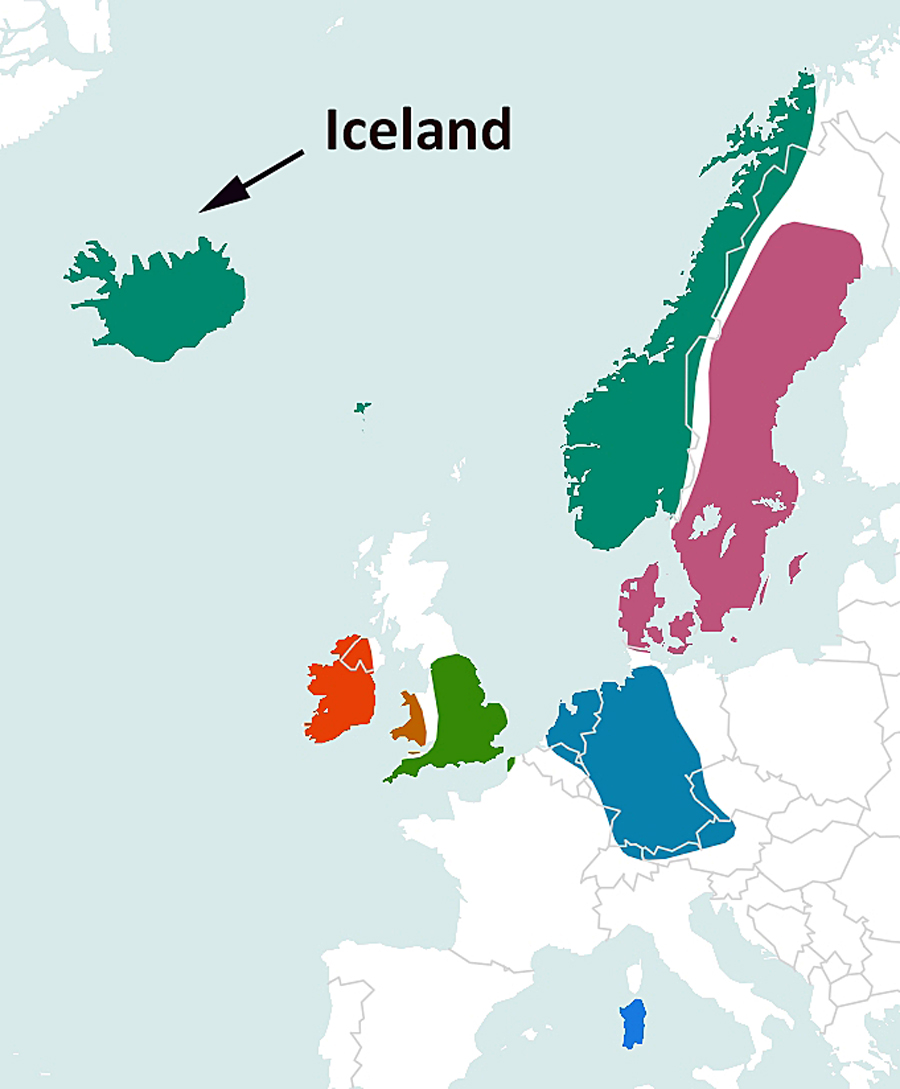
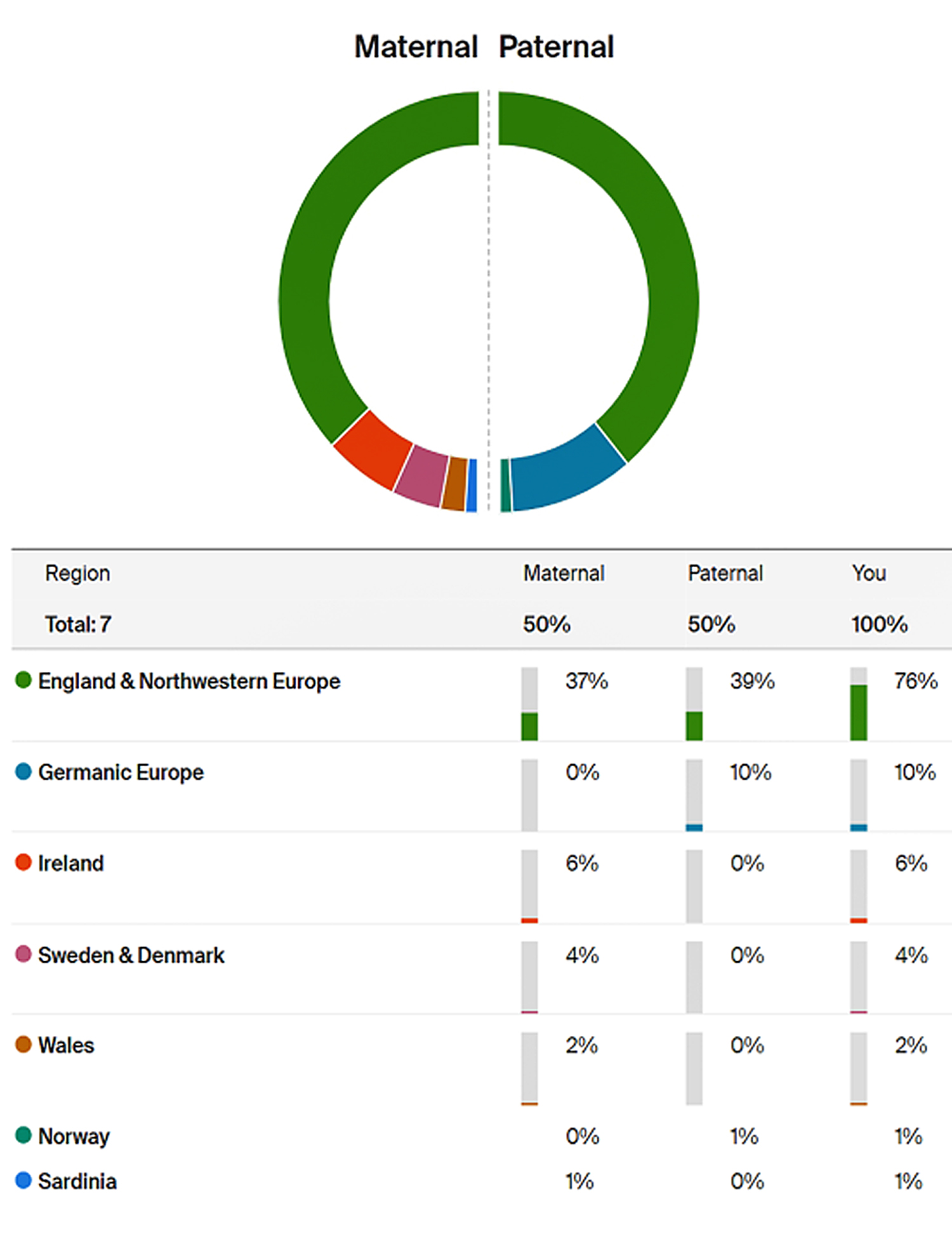
Testing with Ancestry provided the following map indicating the regions of the world where autosomal DNA looks most like mine.  Of peculiarity, atDNA like mine is found in Iceland, Ireland, England, Norway and Sweden, but oddly not in Scotland ….drats! Note that the image (right) is a composite, combining results from both my father and mother. But which is which? Also included in the report is a breakdown of the places most matching my two parents, but again, which place matches which parent? To answer that question all I needed to do was to look separately at reports for known cousins on both my mother and father’s side of the family.  Doing so allowed me to assign places representing atDNA reports most-closely matching each parent.  Ancestry.com provided the following with the assignment of parentage determined by me.

So somehow, I may be made up of a wee bit of Icelandic heritage apparently accounted within the 6% of the Norwegian/Sweden genetic make-up gifted to me by my mother. My mother is the daughter of William Love and Minnie Anne Love who both being distant cousins in the same Love lineage, share a heritage believed to be Scottish/Irish. As for any Viking admixture, it is known ca. 790 that the warrior people raided and lived in the northern reaches of both Ireland and Scotland from which it is believed women were enslaved for wives and in preparation for Viking ventures west to Iceland and beyond. Furthermore, I learned on our trip that Irish Monks may have preceded the Viking move as some say that Irish monks founded a monastery possibly utilizing lava tubes to protect them from the wicked weather. And finally, when enquired about in a genealogy-DNA Facebook Group, friend Tammie Rabon Hudson responded that her mitochondrial (mtDNA) test indicated that her direct matriarchal or female lineage leading to her existence in Stanly County is mapped out as passing from Sweden/Norway in part through Iceland. Like yDNA, mtDNA traces one’s direct maternal lineage deep into time; possibly reaching to a time before surnames were first used.

Believing numerous equally viable and unprovable possibilities exist from which to explain my genetic ties to Iceland, I’d like now to share just a bit on what I learned during my visit concerning Vikings and where they lived on the Island country.

Travelling Road 1, also known as Ring Road around the perimeter of Iceland.

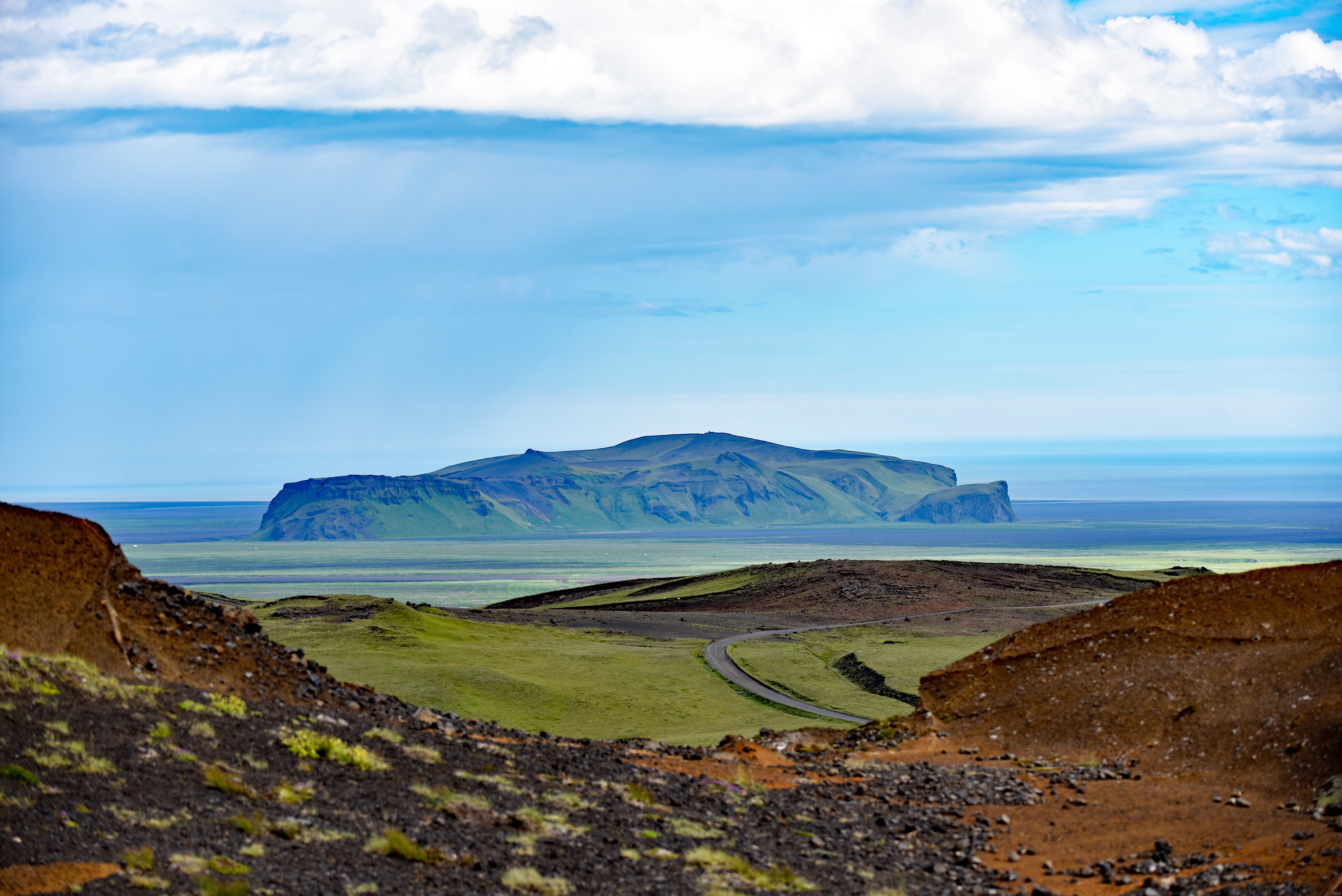
Location names in the Icelandic language are long words, usually formed as composites of several words representing the place in totality. Driving Ring Road beyond the town of Vic (meaning Bay), we passed south of Katla, one of the largest and most explosive volcanos in Iceland. Katla is covered by the large glacier Mýrdalsjökull, meaning “Bog,” “Open Valley,” “Glacier.” We turned north onto F Road 214.  Note that F roads legally require 4-wheel drive and in the case of 214, the road’s common name is Kerlinggardalsvegur which means “Old Lady,” “Shelter,” “Road.” Note that Google is a must for this sort of vacation. The road dead ends into a sheltered camping area suitable for deeper exploration. Nearing the top of the remote road, we came upon Katla Geopark, a grotesque volcanic landscape bringing to mind pterodactyls, tyrannosauruses, and other critters from long before man. And juxtapositioned against all that one may imagine, an overlook peers upon the greenest of green surrounding an enormous glacial flood plain filled with a record amount of black volcanic debris. Seen in the photo below is a dormant and wasting volcanic core rising above it all in the extreme far distance where the glacial wash meets the ocean. The little hill in the distance is a special place in history called Hjörleifshöfði. According to Wiki, the place received its name from the first legendary settlers who lived in Iceland.

Accordingly,

 “Hjörleifr Hróðmarsson was the brother-in-law of Ingólfur Arnarson, Iceland’s first official settler. He settled at Hjörleifshöfði towards the end of the ninth century. There, however, he was slain by his slaves. The slaves fled to Vestmannaeyjar, where Ingólfur took his revenge for his friend and slew them. On the top of the mountain is a mound called Hjörleifshaugur, where Hjörleifr is said to be buried.”

To learn more about this place I advise the reader to look at the following blog site with post written by Regína Hrönn Ragnarsdóttir:

https://guidetoiceland.is/connect-with-locals/regina/the-historical-hjorleifshofdi-promontory-part-ii-the-hike-and-the-inhabitants

Hmmm, could the slaves held at Hjörleifshöfði have been Irish, maybe some distant kin to folks I’d call my own? That’s a maybe, or were they possibly from a time of Norwegian Vikings? Were the Vikings themselves somehow my kin?  So many possibilities and it is important to honestly state that absolution in truth lies far beyond what we can glean from history. Iceland is a land of lore, yet, several days after passing the volcanic plains leading south from the mighty Katla, news spread across Iceland and the world also of a great glacial melting in the spot we had recently visited. Our trip turned into serious business. Maybe from seismic heating underlying the glacier, but certainly enhanced by a wetter than normal summer, the routine and temporary thawing of glacier overran the Ring Road, washing out an important bridge. See: https://www.msn.com/en-us/video/weather/glacial-flood-waters-inundate-road-in-southern-iceland/vi-BB1qMAFQ?ocid=BingNewsSerp&t=8

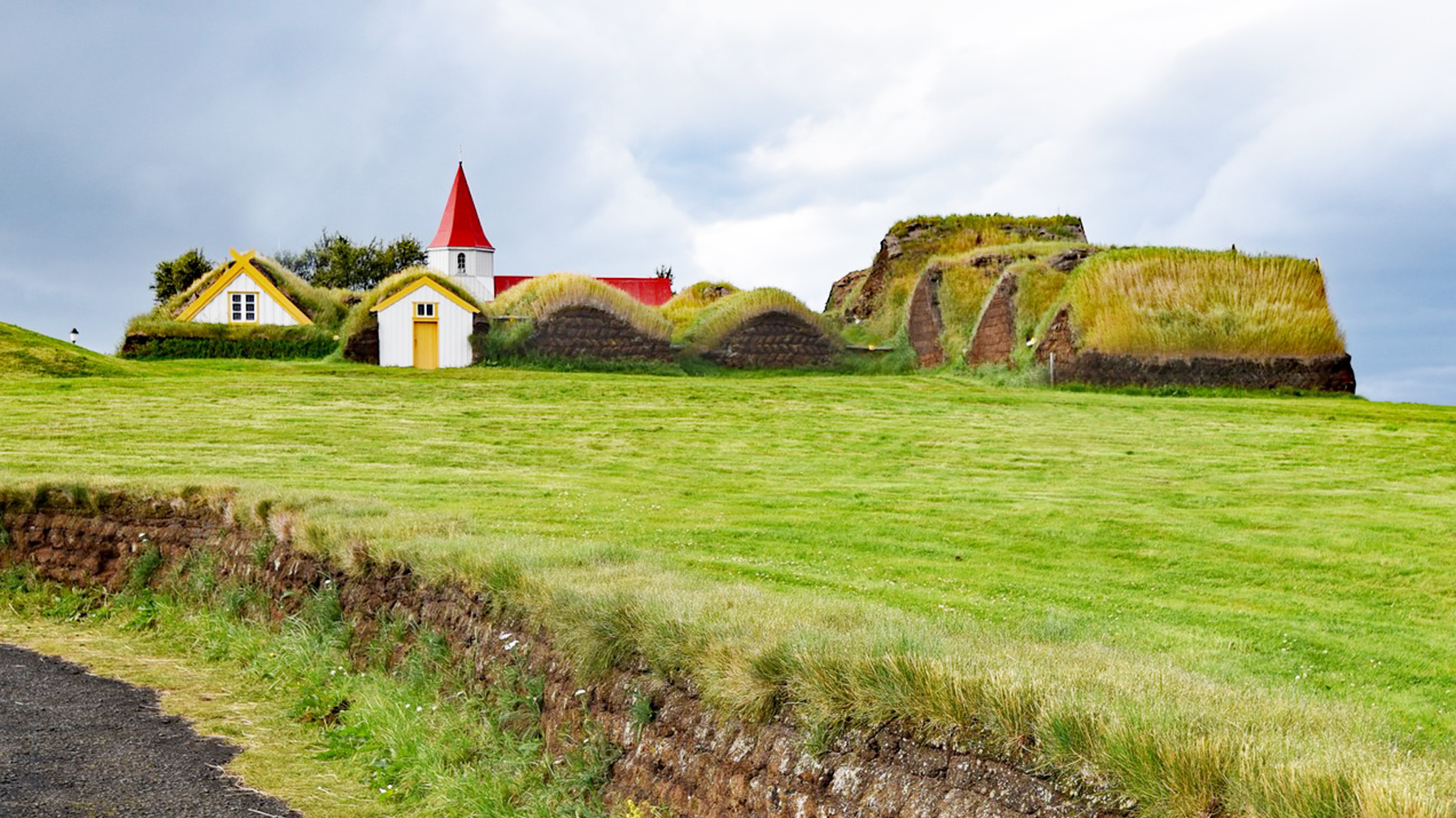
Our adventure carried us to stops up the eastern fjords and east across the country’s North where we finally reached another stay at the farming community of Varmahlíð, which means “Warm,” “Hill.” Timing on such trips require one to cut some of the initially desired stops from the itinerary and in this case, if time had allowed, we could have driven an hour to the north coast where stands a monument to Hrafna-Flóki Vilgerðarsson, a Norseman and important character in The Vikings who intentionally sailed to Iceland in the year 868. During our stay at the Varmahlíð Hotel, prominently placed near the elevator was a poster identifying the various Vikings known to have resided in the region. Also, needing medicine and having to go to the nearby town of Sauðárkrókur, meaning “Sheep,” “River,” “Hook,” we stopped by a small Lutheran Church beside a wonderfully reconstructed Viking Village (below).

The village was made entirely of sod, much like was constructed by Norwegians and others who settled the American West.  And in front of the little church stood a small monument of a mother and child entitled the first mother in America.

At this point our trip turned south and west, towards the Western Fjords and the Snaefellsnes Peninsula where Jules Verne found inspiration to write his novel Journey to the Center of the Earth. But before reaching the peninsula and after passing the southern-most point of Hrútafjörðu, a northwest fjord meaning “Male,” “Sheep,” we chose to head to Snaefellsnes by way of another F road. This time driving on the rugged F 586, we forded a deep stream numerous times on what was the most rugged leg of our journey (see video: https://www.youtube.com/watch?v=IcXGmzYxV18&t=6s). We followed a valley floor where it is said Lief Erikson, the first European to walk on Continental American lands, was born. On F 586 we drove past a reconstructed Viking longhouse rightly called Eiríksstaðir, believed to be the homestead of a person known as Eiríkr Þorvaldsson, otherwise called Erik the Red. Erik had been banished from Norway and would also be exiled from Iceland during which time he explored Greenland where he settled and his life ended. From Wiki, a bio for Eiríkr Þorvaldsson tells of his land:

“a site thought to be that of the original farm has been investigated by archaeologists and remains of two buildings dating to the 9th–10th centuries have been identified. An open-air museum has been established nearby.”

It is believed Leif Eiríksson, Erik the Red’s son, was born in Iceland, possibly at this site. Every school kid has learned of Leif and his walk on the North American Continent before Columbus.

There is much more I want to explore and write about though Iceland is physically very far away and even more so in terms of any genetic path leading to its people.  Yes, it’s possible my folks once walked the land, though it’s far more plausible that I touch ancestry with others who did in fact walk the land. The tools used for researching genetic heritage only improve as sampling broadens with every new person buying the commercially available products.   And for yDNA, I hope someone, someday, will be tested whose data reveals new and undeniable branches of my THOMAS tree deep into time. What a fun trip for now and looking back across the road to Snæfellsjökull, I leave you with a final photo until we meet again …. Skål!

CROSSING BUCKHORN

PURCHASE HERE

“The lives of these people of African, Indigenous, and mixed-race descent
wove their way into my family’s history when we once lived
as neighbors in the Upper Cape Fear River Valley.”
In 1804, Joseph Thomas sold his land in Chatham County to Ishmael Roberts, a person of color who served from North Carolina in the Revolutionary War. Curiosity driven research connected the ancestral heritage of these two men to the remote reaches of Northeast North Carolina, where, for a moment in time, people of African, European, and Indigenous descent peacefully coexisted.  However, constantly changing laws and the inability to consistently and fairly classify people failed in the Crown’s attempt to control the population. The resulting culture expanded slowly, eventually crossing the Cape Fear River, where some settled near Buckhorn Falls. Others removed to the Free State of Indiana. From the 1711 Tuscarora War to life in Indiana to reconstruction era atrocities in North Carolina, this writing details changes in law and related events impacting family and community, particularly including neighbors of color. Never could the author have imagined that his more than thirty years of genealogical research would culminate in connecting his family history to matters of race and history important to us all.
“Of those who stacked the rocks and built the church and homes,
I imagine there were times when some glanced south,
dreaming of days spent along the Cape Fear River.”

PURCHASE HERE

A SURVEYOR’S ERRORS: Green Family Lands on Rocky River

Mistakes made in compiling family histories have repercussions far from the implications of misunderstood documentation such genealogies are built upon. For instance, every online report I have seen on the family of Gideon Green of Anson County, North Carolina, indicates him to be rooted in James Green Jr, of early Bath County, North Carolina. Not so! Gideon of Anson clearly appears in a 1772 Wake County civil action paper alongside Joseph Thomas and people close to a person there named Leonard Green –who happened to settle in the county from earlier in Edgecombe. Probably the father of Gideon Green, Leonard is the son of Richard Green, who passed from Chowan County through Bertie before moving beyond Edgecombe County. The ancestry of Gideon Green does not go back to James, as is colorfully told in error by many.

Looking at just one responsible site, Ancestry.com, nearly 1300 public trees base their genealogies on Gideon wrongly being assessed to be the son of James Green. There are other such sites, including WikiTree, FindaGrave, and FamilySearch. Mistakes are a part of life, but as I have always heard, a mistake is measured by how far back down the dirt road you have to walk to find the tool to fix it, but Wow! –this colossal number makes me laugh –and cry. I remain curious concerning Ancestry.com’s corporate take on how best to handle the spreading of such egregious errors. Do they even care? Thankfully, this writing does not delve into that sort of issue but instead into a simple and common surveyor’s mistake, which I discovered while tracing lands once owned by the family of Gideon Green. I am a retired educator; sorry, much of who I am grows from my love of teaching others. Let’s dig into the Green family lands situated along the Rocky River in old Anson County, now Union County.

_______________________

On Aug 6, 1817, Anson County surveyor John Hough walked the land along the Rocky River and surveyed state grant 6318[A], which would be issued to Jesse Green on Nov 27, 1817. At that time, this son of deceased Gideon and his widow Elizabeth Green, Jesse Green received 200 acres on Rocky River “joining Elizabeth Green’s mill tract.” Note that the grant file number is suffixed with a bracketed letter [A]. The additional letter is used occasionally for clarity’s sake because the file number has been otherwise proven not to be distinct. Furthermore, the surveyor must have been confused as he titled the grant “Lenard Green,” which he struck through before correcting the name to be “Jesse Green.”   See below:

More important is a mistake involving the platting process and how the surveyor interpreted his numbers. Before moving forward, I must ensure the reader understands the process of platting land.


Based on an original compass reading at a given landmark or starting point, a survey plat is comprised of lines chasing one another from tail to head. Land boundaries are defined legally by a series of written descriptions representing hand-drawn boundary lines. Each line description includes two landmarks (tree, rock, or maybe the corner of another person’s land) that mark starting and endpoints. Descriptions also include distance defined by units of the measuring device used in the survey: a pole which equals 16 ½ feet or a chain which equals four poles. Lastly, the surveyor accounts for direction based on degrees east or west from either north or south. To explain this, let’s look at the compass to the right.

For example, look at the red line running northeast. Typically referencing degrees from the North-South axis, if this were a survey line, it would run 50 degrees East of due North. Considering another example, the blue line pointing to the southwest runs 33 degrees West of due South. This type of information appearing in surveys also includes a measured distance for which this scenario uses 64 poles.   Thus, the nomenclature used in survey descriptions typically begins with a starting landmark, such as a red oak (in this example), followed by the abbreviated direction and distance. Finally, descriptions include a stopping landmark such as a dogwood among three pines (in this example). Standing at the stopping point, a compass reading would be made for the new line before that line is measured using either the chain or pole. The terminology is called “metes and bounds,” with the landmarks being the metes (where lines come together) and the bounds being the actual line or vector running some defined direction based on an initial compass reading. As for our red and blue lines above, the metes and bounds may appear in a survey description as follows (if the distance were again 64 poles and the metes were trees as stated).

For the red line:

Beginning at a red oak, runs North 50 degrees East 64 poles to a dogwood among three pines.

For the blue line:

Beginning at a red oak, runs South 33 West 64 poles to a dogwood among three pines.

And for the actual plat or visual representation of the land survey, nomenclature for the above would read:

(Red)  North 50 East 64                (Blue)  South 33 West 64

Hopefully, you have followed thus far, and to test your understanding, let’s look again at the 1817 survey for Jesse Green’s 200 acres, as is shown above. Note from the survey that the first line (running from the rectangular inside corner) runs north 36 chains. See it? Also, note that the North-South axis is oriented horizontally. The next line runs a short distance along the river before heading due South 66 chains. At that point, a line runs South 60 West 40 chains. Does anything look wrong with that line? Taking a quick look at the compass and thinking about what 60 degrees west of due south should look like, the survey plat above appears to be different …in error. The angle drawn on the plat is closer to 30 degrees, while the description says it should be 60 degrees.  I believe the surveyor’s mind was oriented vertically on the paper while the plat was instead oriented horizontally.

My belief is confirmed as the next line is defined as South 5 West 18 chains. A nomenclature typically not used, John Hough oriented the line five degrees south of the horizontal or East-West line instead of basing the line off of the North-South line. If following the standard customarily used, the metes and bounds should instead read South 85 West 18 chains.

If the above survey is redrawn properly oriented, the resulting plat looks different. Note to the right how the corrected line (red) runs in a more horizontal direction and how that results in the lifting of the northwest corner. What was first seen as a rectangular starting point is now an acute angle. Also, note that the adjoining land on the river is described as “Elizabeth Green’s mill tract.”

I now have enough information to incorporate additional sleuthing skills. Most importantly, I can look at adjoining tracts to see if metes and bounds properly relate to my changes to the 1817 survey.

From the present-day Union County GIS map, Jesse Green’s 1817 grant plat is locatable below within the myriad of lines near and downstream of Love Mill Road, where the land’s old boundaries correspond somewhat with today’s property lines. However, much time has passed, and today’s property lines must not be seen as perfectly accurate concerning the old plat though they can be very helpful in narrowing down the search for where people once lived and worked.

Using Google to zoom further on an aerial view of the site, tree lines, and other landmarks related to the lay of the land can be used in one’s search. In this case, Elizabeth Green’s mill tract is located in a bend where I can imagine the family damming the water within a narrow passing between an island and the bank of the river. Drilling even deeper into the image (below), one may imagine the exact location of an old mill dam and where best to look for remnants of it today. And for those interested, note that the nearby road is called Love Mill Road because Charles C. Love once operated yet another mill situated a short distance west of the bridge on the Stanly County side of the river.

Beyond identifying Jesse Green’s granted land and the mill tract once owned by his mother, Elizabeth, the location above allows me to begin putting back together some of the adjoining ownership.  Though the following may not be perfectly accurate, I believe it should be useful in understanding the early Green family and their start in Anson County. Looking at the image below, Weatherford Branch enters Rocky River on the extreme western edge of the map while Grassy Creek can be seen entering the river to the east.  See them?  Shaded pink, Peter May received a grant of land east of Weatherford along the present-day Love Mill Road. Notice how nicely that piece of land mates to Jesse Green’s yellow shaded tract. And joining Jesse’s land on the long North-South line to the east, his mother Elizabeth received the red shaded tract. And east of that land is Elizabeth Green’s grant for land which roughly reflects the big bend in Rocky River.

Of interest and remembering me writing about how errors live long after their incidence? –let’s take a deeper look at Nathan Green’s land. Shaded blue, that tract joins Jesse Green’s land and the questionable line that I believe was measured correctly, though drawn on plat incorrectly.  Note that Nathan’s grant survey calls out a line as South 60 West 40 chains, which reflects the corrected angle.  The land’s southeastern line is also defined in the grant as running along Grassy Creek.  That fact is important in allowing me to position the land.

However, for some reason, Nathan’s blue shaded tract calls out the line joining Elizabeth’s red tract as North 70 West 33.5 chains. As for Elizabeth’s red shaded tract, the same line is called out as North 70 East 33.5 chains. Somehow influenced by the previously noted error, the length and degree of the lines are the same though one is said to run northeast while the other southeast.   A simple mistake, I wonder about impact and how the remaining line on Nathan’s tract should be interpreted. The answer will be known upon my learning how the adjoining owners called out their land holdings.  Ugh ….but for now let’s no go any further with that matter.  Instead, while in the neighborhood, let’s take a look at other lands owned by the Green family.

Looking upstream, beyond Elizabeth’ Green’s land and beyond Love Mill Road, the first stream entering Rocky River is Weatherford’s Branch.  And beyond Weatherford’s is the mouth of Crooked Creek which rises in nearby Mecklenburg County.  Spanning the two streams along the river are two adjoining tracts issued to John and Leonard Green (see below).  That land later passed through Peter Hagler who I believe operated a mill on the land, maybe originating with the Green family.

Now looking downstream in the opposite direction, remember Nathan and his mother Elizabeth Green’s land ended in the vicinity of Grassy Creek as has already been shown.  Bordering Grassy Creek, Leonard Green, son of Gideon and Elizabeth received a grant for land along the river (reddish brown). To the east of that land, John Culpepper deeded land to Jacob Green in 1778 (pink).  Note that this Jacob is a brother or other relation to Gideon as his son of same name was born later. So, here we have members of the earlier family acquiring land very close to each other.  Later acquisitions in the area include two more tracts by Jacob Green, though I’ve not yet established the relationship (blue and green).  In the middle of it all is Jonathan Austin’s grant who later acquired Leonard Green’s River tract.

There are other pieces of land which I have yet to resolve.  For now, the following gives a glimpse at additional Green family lands west of Grassy Branch. More later…


MELUNGEONS IN THE FAMILY?

Just as curiosity and the search for new “stuff” are never-ending, so are new findings and their implications on the story being written. From a recent Google Search:

ANDREW AND DAVID COLLINS. I am looking for info on David Collins who died in Stewart Co sometime after 1813 when he filed a power of attorney with William Skiles on the estate of his brother Bennett Collins in Bertie CO NC. Andrew Collins married Mary/Polly Barnes I believe is his son. I am looking for a death date for David and a name for a possible second wife. His first wife was Annis Collins from deeds in Bertie CO. NC. They left Bertie about 1806/07. David sold a slave in 1807 to Parry Humphrey in Montgomery County TN. They may have been in Humphrey CO for a while too. Andrew Collins is the one in the 1850 census. Can anyone help. Look for possible estate papers for David in Stewart Co.
Todd,
XXXXXXXemail addressXXXXXXXXXXXXXXX
Submitted on Wed Sep 23 22:23:25 CDT 2009

Found in an old online Stewart County Tennessee query page, the preceding represents another chapter in the story of Michael Thomas, who lived and died in Bertie County, North Carolina. The son of Joseph Thomas (II), who died circa 1758, Michael Thomas named his wife Anney in his 1766 last will and testament. Looking at deeds and the related loose estate papers, the name of Michael’s widow changes in time from Annis Thomas to Annis Collins.

Mar 1767, Bertie – ordered that Annie Thomas Exx of Michael Thomas sell the perishable part of the estate of the said Michael.

Feb 1776, Bertie – Ordered that David Standly, Peter Clifton, Zedekiah Stone and Watkin William Wynns and John Watson or any three of them lay off the third part of the real estate of Michael Thomas deceased for the use of his widow and relict Annis Collins and that they make return of their proceedings therein to next court

David Collins is appointed guardian of Anney and Michael’s daughter Judeth and then in 1786, David Collins and wife Anney sell their land on Beaver Dam Swam which is located northeast of the Cashie Swamp. At that point the trail runs dry for me here in North Carolina. However, “Todd” in Tennessee clearly has more to offer as indicated above.

It is known David Collins is the son of Joseph Collins and Rachel Bunch, with Rachel being the daughter of Henry Bunch, who happens to be mixed-race.

As for David Collins’s uncle, Jeremiah Bunch, he is widely remembered for his house-building skills. Now relocated a mile through Bertie County peanut fields from its original location, the 1700s Jeremiah Bunch homeplace once stood across the road from the homeplace of Michael Thomas’ brother, Josiah Thomas. Nearby, if not adjoining to the north are the lands once owned by Michael Thomas, who served as Josiah’s guardian following their father’s passing. And for David Collins’ father,  Joseph Collins, part of his land purchased from the Thomas family is situated across the Cashie River to the east.

Looking back to the Stewart County  USgenweb post from 2009, “Todd” must surely have stories he could tell concerning his possible mixed-race heritage. Seeking to make contact, which has not yet taken place, I was able to glean much from the outdated email address Todd used in his inquiry. It turns out that in 2013 Todd Beckham and Marilyn Cheney co-produced an award-winning short film titled The Melungeons. Directed by Ian Cheney, the film is found on the Wicked Delicate Films site where it can be rented or purchased at a reasonable cost.  Furthermore, the following is a link to the trailer for The Melungeons:


<p><a href=”https://vimeo.com/65063607″>The Melungeons</a> from <a href=”https://vimeo.com/wickedelicate”>Wicked Delicate Films</a> on <a href=”https://vimeo.com”>Vimeo</a&gt;.</p>

Too often we bind ourselves to the task of building “trees” while stories often hidden in the background offer a much more meaningful narrative – such as that told on film by Todd Beckham. I wonder how the learning process impacted Todd’s understanding and appreciation of his oh-so “typical” American family?